Authors: Pralay Biswas, Rashi Jain, Yogesh Wadadekar
Categories: astro-ph.GA
Optically Invisible Galaxies at Cosmic Noon and beyond with JWST/UNCOVERJournal: ApJFacilities: JWST, HSTastropy (25; 23; 24), numpy (41), matplotlib (43), pandas (53; 75), ds9 (68; 45; 46; 47; 48), TOPCAT (74)
Pralay Biswas OrcID: 0009-0002-2173-0953 Affiliation: National Centre for Radio Astrophysics, Tata Institute of Fundamental Research, Post Bag 3, Ganeshkhind, Pune 411007, India Email: pbiswas@ncra.tifr.res.in
Rashi Jain OrcID: 0009-0002-9692-3899 Affiliation: National Centre for Radio Astrophysics, Tata Institute of Fundamental Research, Post Bag 3, Ganeshkhind, Pune 411007, India Email: rjain@ncra.tifr.res.in
Yogesh Wadadekar OrcID: 0000-0002-1345-7371 Affiliation: National Centre for Radio Astrophysics, Tata Institute of Fundamental Research, Post Bag 3, Ganeshkhind, Pune 411007, India Email: yogesh@ncra.tifr.res.in
Abstract
The traditional selection bias in high-redshift galaxy surveys toward rest-frame ultraviolet emission has constrained our understanding of the high-redshift universe by systematically excluding optically faint (observer-frame) galaxies. Utilising JWST UNCOVER and MegaScience data of the Abell 2744 cluster field, we identify 113 high-redshift (z>2) and 94 low-redshift (z<2) HST-dark galaxies using a red 1.50-3.56 μm color criterion. Their physical properties were derived using multiwavelength photometry from 20 JWST/NIRCam and 7 HST filters. Unlike classical submillimeter and Spitzer-selected HST-dark galaxies that primarily identify the most massive, dusty, highly star-forming galaxies, our study uncovers a moderately dusty population across a significantly broader range of stellar mass and star-formation rate. Leveraging gravitational magnification and ultra-deep JWST imaging, we found HST-dark galaxies with a stellar mass as low as 10⁷.⁵ at z>2. These galaxies have smaller sizes and follow the star-forming main sequence. Our analysis reveals a prominent peak in the Star Formation Rate Density at z≈ 4.5 (9.89⁺⁶.⁹³₋₄.₃₄ × 10⁻³ M_⊙ yr⁻¹ Mpc⁻³). We also characterise a sub-population at z<2 of Highly Extincted Low-Mass analogues with extremely low stellar masses (median ) and high dust extinction (median A_V ≈ 1.97 mag). Our sample demonstrates the unique power of JWST to reveal this previously missing galaxy population and to provide a more complete census of galaxies in the high-z universe.
Keywords:
Galaxies: high-redshift — Galaxies: structure — Galaxies: evolution — Infrared: galaxies — Cosmology
I Introduction
Tracing the history of star formation and mass assembly across cosmic time remains one of the paramount goals of modern extragalactic astronomy. At redshifts of z>3, the rest-frame optical emission from galaxies redshifts entirely beyond the wavelength coverage of the Hubble Space Telescope (HST). Consequently, understanding of early star-forming galaxies, such as Lyman Break Galaxies (LBGs), has historically relied almost entirely on rest-frame ultraviolet (UV) observations. This severe UV bias has long been suspected to result in an incomplete census of galaxies in the early Universe. The presence of interstellar dust severely attenuates UV emission, rendering heavily obscured systems completely invisible to the high-redshift optical surveys in the observed frame. Similarly, massive quiescent galaxies, which have very little to no star formation and lack bright, young UV-emitting stars, also remain hidden from traditional optical dropout selection criteria for high-redshift galaxies, creating a critical gap in our understanding of the early universe.
Although extremely dust-obscured star-forming galaxies, such as submillimeter galaxies (SMGs), have long been known to exist at z>4, they remain rare. In fact, classical SMGs are roughly 100 times less common than LBGs, with a very low sky density of only ∼ 0.01 arcmin-2 (61; 52). Because of this rarity, these classical SMGs contribute only a limited fraction (3; 54, 10-15%;) to the integrated cosmic star formation rate density (SFRD). Similarly, while massive quiescent galaxies have been identified up to z∼ 3-5, they have also historically represented a notably rare population at these early epochs (73; 19; 66; 76; 50; 71). Consequently, it is highly likely that early cosmic star formation and stellar mass buildup are not actually dominated by these rare extremes, but rather by more typical dusty star-forming galaxies (DSFGs) that evaded traditional rest-frame UV selection.
The historical effort to uncover these optically invisible “HST-dark” galaxies relied heavily on combining HST optical data with near-infrared imaging from the Infrared Array Camera (IRAC) on the Spitzer Space Telescope (42; 16; 70; 79; 80; 34; 1; 35). However, these early studies were severely limited by Spitzer/IRAC’s low sensitivity and broad point-spread function (PSF), which frequently led to severe blending and source confusion in crowded deep fields, complicating accurate photometry. Also, the availability of limited photometric information, with only a few wide bands, makes spectral energy distribution (SED) modelling via stellar population synthesis (SPS) and redshift estimation uncertain. The advent of the James Webb Space Telescope (JWST) has fundamentally transformed this observational landscape. With its unparalleled sensitivity, multi-band broad and medium filter coverage in the near-infrared (spanning λ=1-5 μm), and high spatial resolution, the JWST Near-Infrared Camera (62; 63; 40; 64, JWST/NIRCam;) allows us to resolve and identify these red, optically dark sources to much fainter limits.
Early JWST photometric analyses of these sources, using data from the Cosmic Evolution Early Release Science Survey (33, CEERS;), revealed a fundamental “triality” in the nature of HST-dark galaxies (59). Based on their spectral energy distributions (SEDs), these extremely red sources could be one of three distinct populations: massive, dusty star-forming galaxies at z∼ 2-6; massive quiescent or dormant galaxies at z∼ 3-5; or strong young compact starbursts with high equivalent width emission lines at 6<z<7. Degeneracies arising from being restricted to the only photometric data made it extremely difficult to distinguish between these scenarios in the absence of spectroscopic data. However, recent dedicated spectroscopic follow-up with JWST Near Infrared Spectrograph (44; 14, JWST/NIRSpec;) has successfully broken this degeneracy. As demonstrated by 4, spectroscopy of these extremely red galaxies at z>3 confirms that the population is a diverse mix; while many are heavily dust-obscured and star-forming galaxies with wide rage of Hα equivalent widths (), a significant fraction are indeed quiescent galaxies, proving that these massive systems were systematically missed by earlier optical samples.
Crucially, the dusty star-forming galaxies within the “HST-dark” population differ fundamentally from classical submillimeter galaxies. Analysis by 5 has shown that, unlike classical SMGs, which typically reside well above the star-forming Main Sequence (SFMS) due to their high mass and bursts of star formation, these HST-dark galaxies are predominantly less massive systems with relatively lower star formation rates (SFRs), placing them on the SFMS. Their inclusion in the cosmic census is necessary to achieve an accurate understanding of galaxy evolution; they represent a highly significant contribution to the galaxy mass function and could substantially contribute to the obscured SFRD at early epochs. Furthermore, recent findings of even redder systems, such as “NIRCam-dark” galaxies that appear only in JWST Mid-Infrared Instrument (39; 82, JWST/MIRI;) observations (60, e.g., the source “Cerberus”;), indicate that the early Universe contains heavily obscured populations that are missing even in the deepest near-infrared surveys with JWST/NIRCam.
While recent JWST wide-field surveys have successfully characterised the bright and high-mass end of the HST-dark population (5; 59; 4; 38), understanding the complete evolutionary picture requires extending our census to the intrinsically fainter, lower-mass sources that better represent the typical building blocks of the Universe. This study addresses this critical gap by utilising ultra-deep NIRCam imaging from the JWST Ultradeep NIRSpec and NIRCam ObserVations before the Epoch of Reionization (6, UNCOVER;) survey, deliberately capitalising on the gravitational lensing magnification provided by the massive foreground cluster Abell 2744. By probing the magnified galaxies behind this lensing cluster, we aim to uncover the intrinsically faint, lower-mass counterparts to the recently discovered massive HST-dark galaxies in unlensed JWST fields. Using gravitational lensing, we aim to determine whether the highly dust-obscured, main-sequence nature of these sources extends to the fainter galaxies, thereby providing an essential, hitherto missing piece to the puzzle of cosmic stellar mass assembly.
This paper is organised as follows. Section II describes the observational data from the UNCOVER survey and our sample selection. Section III outlines the SED modelling with BAGPIPES. We describe the low redshift (z<2) “HST-dark” galaxies in Section [IV](#S4 "IV Low redshift (
        <
        z
        2


  ) HST-dark Galaxies ‣ Optically Invisible Galaxies at Cosmic Noon and beyond with JWST/UNCOVER"). In Section [V](#S5 "V Results and Discussion ‣ Optically Invisible Galaxies at Cosmic Noon and beyond with JWST/UNCOVER"), we present our results, including the variety of physical properties and morphologies, compare our galaxy sample to SMGs and bright HST-dark sources, and discuss their contribution to the cosmic SFRD. We summarise and conclude the paper in Section [VI](#S6 "VI Summary and Conclusion ‣ Optically Invisible Galaxies at Cosmic Noon and beyond with JWST/UNCOVER"). Magnitudes are given in the AB system ([57](#bib.bib57)), and where necessary, we adopt a standard ΛCDM cosmology with H₀=67.4kms⁻¹ Mpc⁻¹, Ωₘ=0.315, and Ω_Λ = 0.685 ([26](#bib.bib26)).
II Data and Sample Selection
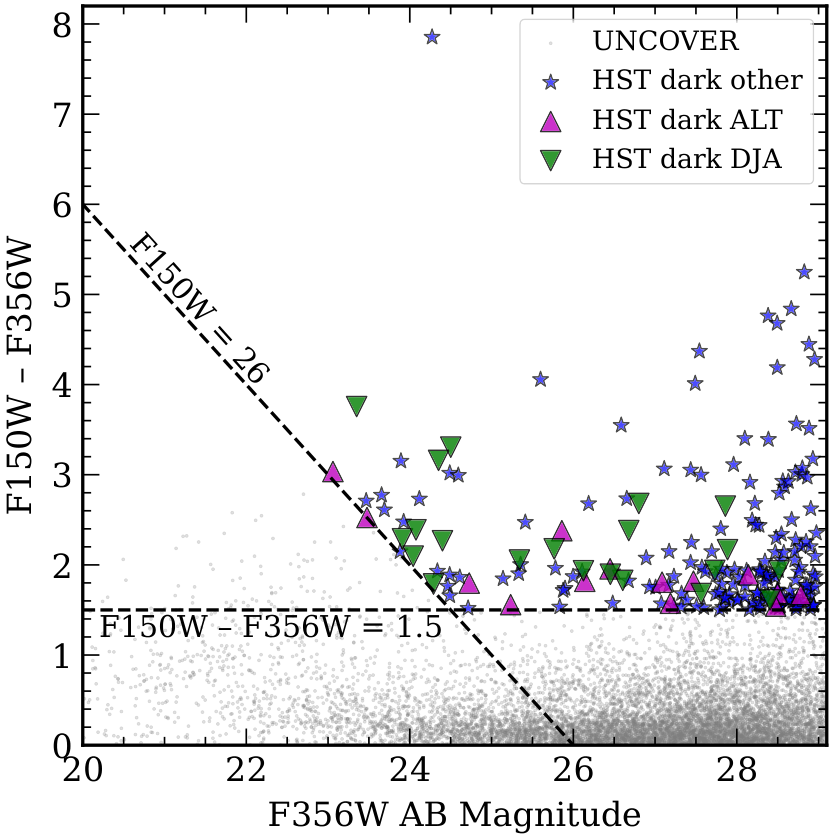
Figure 1: color-magnitude (F150W–F356W vs F356W) diagram to select HST-dark galaxies. The black dashed lines show the color cut F150W - F356W = 1.5 and the F150W = 26 mag limit. The grey points represent the entire UNCOVER sample from the “SUPER” catalogue. The blue stars are the selected HST-dark galaxies with no spectroscopic data. The magenta upper triangle and green lower triangle, respectively, represent HST-dark galaxies with spectroscopic data from the ALT and DJA.
Our analysis utilises ultra-deep imaging of the Abell 2744 lensing cluster (z=0.308) from the UNCOVER (6) treasury survey and the MegaScience medium-band survey (72) taken from the UNCOVER data release 3 (DR3). UNCOVER survey (JWST Cycle 1) provides deep imaging over ∼ 45 arcmin2 in seven NIRCam filters, including six broad-band filters (F115W, F150W, F200W, F277W, F356W, and F444W) and one medium-band filter (F410M). These observations reach 5σ limiting magnitudes of ∼ 29.5-30 AB mag, providing the sensitive long-wavelength “anchor” necessary to detect the dusty continuum of HST-dark galaxies. The MegaScience survey (JWST Cycle 2) builds upon the UNCOVER survey by contributing the remaining NIRCam filter set, including the two bluest broad-band filters (F070W and F090W), and 11 additional medium-band filters (F140M, F162M, F182M, F210M, F250M, F300M, F335M, F360M, F430M, F460M, and F480M). Together, these programs provide a continuous sampling of the spectral energy distribution (SED) from 0.7 μm to 5.0 μm. The inclusion of the medium bands is critical for our analysis, as they allow for the precise identification of strong emission lines (e.g., Hα, Hβ, and [OIII]) and a more accurate characterisation of the spectral energy distribution, significantly reducing the uncertainties in the stellar population modelling parameters and, most importantly, in the redshift (72). We have used data from the UNCOVER Data release (DR) 3, which includes other JWST observations apart from UNCOVER (GO-2561, PI: Labbe & Bezanson) and MegaScience (GO-4111, PI: Suess), like MAGNIF (GO-2883, PI: Sun), ALT (GO-3516; PI: Naidu & Matthee), GO-3538 (PI: Iani), ERS-1324 (GLASS), and DD-2767. We also utilise the re-processed Hubble Space Telescope (HST) mosaics and photometry provided by the UNCOVER team (81), which include photometry from 3 ACS/WFC (F435W, F606W, and F814W) and 4 WFC3/IR (F105W, F125W, F140W, and F160W) filters from #11689 (PI: Dupke), #13386 (PI: Rodney), #13495 (PI: Lotz / HFF), #13389 (PI: Siana), #15117 (PI: Steinhardt / BUFFALO), #17231 (PI: Treu), #13495 (PI: Lotz / HFF), and #15117 (PI: Steinhardt / BUFFALO).
The significant gravitational lensing magnification provided by the Abell 2744 cluster in the UNCOVER survey allows us to observe galaxies that are intrinsically 1.5–4 times fainter than those found in other deep JWST surveys such as the Cosmic Evolution Early Release Science Survey (33, CEERS;). The combination of deep medium-band photometry and lensing magnification provides the most complete census of optically dark galaxies at cosmic noon and beyond.
We isolate our sample using a JWST-only color-magnitude criterion applied to the UNCOVER+MegaScience photometric ‘‘SUPER” catalogue¹ (81, hereafter SUPER catalogue;) taken from the UNCOVER DR3. The “SUPER” catalogue provides photometry from optimally selected color apertures covering all JWST imaging available in the Abell 2744 field over an area of ∼ 56 arcmin². It also provides identification flags for the stars and artefacts. The catalogue is based on F444W PSF-matched imaging in which the bright cluster galaxies and the intra-cluster light have been modelled and subtracted. In addition, we have used the use_phot flag provided in the catalogue. This is a SUPER flag which separates robust sources (use_phot = 1) from the marginally detected sources, stars, artefacts, and objects with no usable photometry (use_phot = 0). Our primary selection requires:
https://jwst-uncover.github.io/DR3.html#PhotometricCatalogs
. The F150W-F356W color we use serves as a proxy for the H-[4.5] color used in legacy H-dropout studies using Spitzer/IRAC (16; 79; 59; 4), while benefiting from the high sensitivity of the JWST. Importantly, our use of a faint limit as F356W≤29 allows us to probe a lower-mass population of galaxies (). Using these selection criteria, we found 662 galaxies. We visually inspected multi-band cutouts of all these sources twice and removed residual artefacts, diffraction spikes, noise peaks, and objects detected in only one band to obtain a robust sample. After this, our final sample includes 208 HST-dark galaxies (see Figure 1).
Some of our sample galaxies are likely to have JWST spectroscopic data. To check this, we cross-matched our final sample of HST-dark galaxies with the Dawn JWST Archive² (hereafter DJA) and All the Little Things³ in Abell 2744 (55, hereafter ALT;) survey. For cross-matching, we used a matching radius of 0.1 arcsec. The DJA is a public JWST data repository. We have matched our final sample of 208 galaxies to the latest JWST/NIRSpec spectroscopic catalogue (version 4.0) available in DJA. 27 galaxies from our sample have spectroscopic data in the DJA. We decided to use DJA spectroscopic redshifts only for galaxies with high-quality spectra (grade =3). After removing 5 galaxies⁴ with grade <3 spectra, we were left with 22 galaxies with DJA spectra in the Able 2744 field. ALT is a JWST Cycle 2 survey that carried out NIRCam grism spectroscopy of small dwarf galaxies. ALT has spectroscopic redshifts measured for 1630 galaxies. After cross-matching our sample with the ALT catalogue, we found 23 galaxies. There were 9 galaxies present in both ALT and DJA. For these 9 common galaxies, the redshifts from DJA and ALT are similar, so we used the DJA redshifts. Therefore, using DJA and ALT data, we have a total of 36 HST-dark galaxies with known spectroscopic redshifts.
https://dawn-cph.github.io/dja/
https://zenodo.org/records/13871850
One of these galaxies is the UNCOVER-z13 (77, MSA ID 13077;).
III Stellar Population Synthesis (SPS) and redshift distribution
Figure 2: Distribution of redshift for the 208 HST-dark galaxies is shown. Along with the high redshift (z>2) HST-dark galaxies, we can also see a population of low redshift (z<2) HST-dark galaxies. We can also see one Lyman-break galaxy in our sample at z=12.34.
We use Bayesian Analysis of Galaxies for Physical Inference and Parameter EStimation (18; 17, BAGPIPES;) to estimate the physical properties of HST-dark galaxies. BAGPIPES is a Python program based on the Bayesian framework for SPS modelling of galaxies. It rapidly generates complex model galaxy spectra from the far-UV to the microwave by synthesising stellar populations, dust attenuation, and nebular emission, and can be fitted to a combination of observed photometric and spectroscopic data.
For this analysis, we employ the 2016 version of 13 SPS models, which uses the Medium-resolution Isaac Newton Telescope library of empirical spectra (28, MILES;) for the UV-optical region of the spectrum. The models are implemented assuming a 49 initial mass function. We model the star formation history (SFH) using the flexible delayed-τ model, allowing for a wide range of stellar ages and formation times. Given the likely dusty nature of HST-dark galaxies, we model dust attenuation using the 15 prescription, allowing the V-band attenuation (A_V) to vary across a wide range of priors from 0 to 6. This high upper limit of 6 is necessary to capture the heavy dust obscuration characteristic of these galaxies, which are often invisible in the rest-frame ultraviolet. One of the critical components of our modelling is the inclusion of the nebular emission. BAGPIPES implements this by using the latest version of the Cloudy photoionisation code 29 to self-consistently model the nebular continuum and line emission alongside the stellar continuum. We included nebular emission by varying the ionisation parameter (log U) from -4 to -2. The choice of BAGPIPES models, model parameters, and priors is summarised in Table 1. The posterior distributions of the parameters are sampled using the MultiNest nested sampling algorithm (31; 30; 32), ensuring a robust exploration of the multi-dimensional parameter space and providing reliable uncertainties for the derived physical quantities.
We use 27-band multiwavelength photometry from the SUPER catalogue in the UNCOVER data release 3 (DR3), as described in Section II, for the SED modelling. We have also used the magnifications available from the UNCOVER DR4 SUPER magnifications catalogue v2.0⁵, which include magnifications for all the objects in the DR3 SUPER catalogue (36; 58) to demagnify the flux densities available in the SUPER catalogue before providing them as inputs to BAGPIPES. An error of 5% was added in quadrature with the uncertainty given in the SUPER catalogue to account for any systemic and calibration uncertainties following the prescription of 12; 78. For the 36 galaxies with spectroscopic redshift available from the DJA and ALT, we fixed the redshift for the SED fitting, and the other SPS parameters were the same as in Table 1.
https://jwst-uncover.github.io/DR4.html#UpdatedLensMag
Figure 2 shows the redshift distribution of the 208 HST-dark galaxies. Given the high redshift nature of the HST-dark galaxies, we expected our sample to be dominated by galaxies at z>2. However, we see a significant population of HST-dark galaxies (94 in number) at z<2. We also see one Lyman break galaxy at z=12.34⁶ As Lyman break galaxies are fundamentally different from the HST-dark galaxies that are the focus of this paper, we have removed the z=12.34 galaxy from further study. This paper mainly focuses on the primary sample of HST-dark galaxies (113 galaxies) with z>2. HST-dark galaxies will refer to this primary sample unless explicitly mentioned otherwise. Before discussing the primary sample, we now briefly discuss the low redshift (z<2) HST-dark galaxies in Section [IV](#S4 "IV Low redshift (
        <
        z
        2


  ) HST-dark Galaxies ‣ Optically Invisible Galaxies at Cosmic Noon and beyond with JWST/UNCOVER").
This galaxy is known as the GHZ2/GLASS-z12 (56; 20; 21).
Table 1: Summary of BAGPIPES Model Parameters and Priors for the HST-dark Galaxy Sample.
| Component | Parameter | Prior Distribution | Range/Value |
|---|---|---|---|
| Stellar Population | IMF | Fixed (Kroupa & Boily 2002) | – |
| Star Formation History | Model | Delayed τ | te⁻t/τ |
| Age (Gyr) | Uniform | [0.1,Age of Universe] | |
| τ (Gyr) | Logarithmic | [0.01,10] | |
| log(M_∗/M_⊙) | Uniform | [4,15] | |
| Metallicity (Z/Z_⊙) | Logarithmic | [0.01,2.5] | |
| Dust Attenuation | Model | Calzetti (2000) | – |
| A_V (mag) | Uniform | [0,6] | |
| Nebular Emission | log(U) | Logarithmic | [-4,-2] |
| Redshift | z | Uniform | [0,15] |
IV Low redshift (z<2) HST-dark Galaxies
Figure 3: Histogram of the redshift (upper left), stellar mass (upper right), SFR (lower left), and dust attenuation (lower right) of HST-dark (z<2) galaxies. The respective median values are shown with red lines. We can see that these galaxies have lower mass, very low SFR, and high dust attenuation.
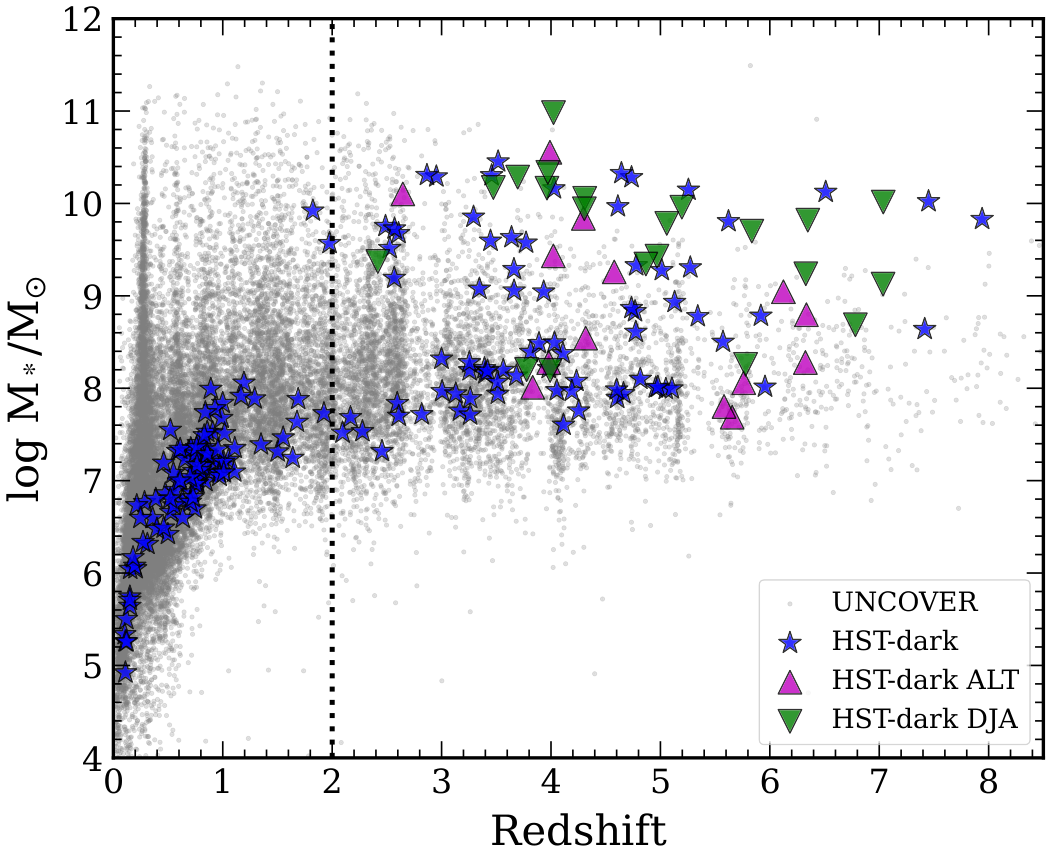
Figure 4: Distribution of stellar mass is shown with redshift. The grey points are the whole UNCOVER sample. The blue stars represent HST-dark galaxies with no spectroscopic data. The magenta upper triangle and the green lower triangle HST-dark galaxies have spectroscopic data from ALT and DJA, respectively. The plot shows that the HST-dark galaxies with z<2 have lower stellar mass and are not a complete sample. The HST-dark galaxies with z>2 have higher stellar masses and are a complete sample.
While the primary focus of our HST-dark selection is the high-redshift (z>2) universe, our sample selection criteria also identify a significant sub-population of 94 galaxies residing at lower redshifts (z<2). They exhibit a median redshift of z≈ 0.76 (ranging from z≈ 0.1 to 1.98) and possess physical properties that deviate starkly from the standard scaling relations observed in the local universe.
See Figure [3](#S4.F3 "Figure 3 ‣ IV Low redshift (
        <
        z
        2


  ) HST-dark Galaxies ‣ Optically Invisible Galaxies at Cosmic Noon and beyond with JWST/UNCOVER") for the distribution of HST-dark galaxies with z<2 in redshift, stellar mass, SFR, and dust attenuation. This low-redshift sample is characterised by extremely low stellar masses and disproportionately high dust attenuation. The median stellar mass is $\log M_{\star}/M_{\odot}\approx 7.10$, placing these objects firmly in the dwarf galaxy regime. Despite their low masses, they exhibit a median dust extinction of A_V ≈ 1.97 mag, with a maximum value reaching A_V ≈ 5.71. These properties are remarkably similar to the Highly Extincted Low-Mass (HELM) galaxies identified by [7](#bib.bib7); [8](#bib.bib8). Like the HELM population, our z<2 sources show significantly higher dust attenuation and extremely low SFRs, with a median SFR≈ 0.009 M_⊙ yr⁻¹.
Figure [4](#S4.F4 "Figure 4 ‣ IV Low redshift (
        <
        z
        2


  ) HST-dark Galaxies ‣ Optically Invisible Galaxies at Cosmic Noon and beyond with JWST/UNCOVER") shows redshift vs stellar mass for the whole sample. It is evident that these z<2 galaxies have lower stellar mass and are only visible at lower redshifts, due to the Malmquist bias. We have also plotted our sample in the A_V vs log(sSFR) plane (Figure [5](#S4.F5 "Figure 5 ‣ IV Low redshift (


        <
        z
        2


  ) HST-dark Galaxies ‣ Optically Invisible Galaxies at Cosmic Noon and beyond with JWST/UNCOVER")). It shows that HST-dark galaxies with z<2 have systematically lower sSFR and higher dust. Therefore, the presence of these galaxies in our HST-dark catalogue is a direct result of their intrinsic faintness, driven by a combination of low stellar mass and low SFR, further exacerbated by significant dust. These “dusty dwarfs” are essentially the low-mass extension of the massive HST-dark galaxies, but this population can now be detected due to the extreme sensitivity of the JWST, albeit only at low redshifts.
Most of these z<2 galaxies are detected in only 3 to 4 longer wavelength bands of NIRCam. As a result, their SEDs are not properly constrained, and so they often exhibit broad photometric redshift posterior (P(z)) distributions. This redshift ambiguity arises also because the red, dusty continuum of a low-mass dwarf at z∼ 0.8, which can closely mimic the spectral shape of the Lyman break in an ultra-high redshift galaxy (z>10). This “interloper” problem has been frequently encountered in recent JWST surveys, where dusty low-z dwarfs are frequently misidentified as high-z candidates before being classified correctly through more rigorous SED fitting or spectroscopic follow-up (85; 2; 7; 86). The broad P(z) distributions for our z<2 sample suggest that while they are likely HELM-like analogues, a small fraction could potentially be higher-redshift contaminants, necessitating future NIRSpec observations to definitively break the age-dust-redshift degeneracy.
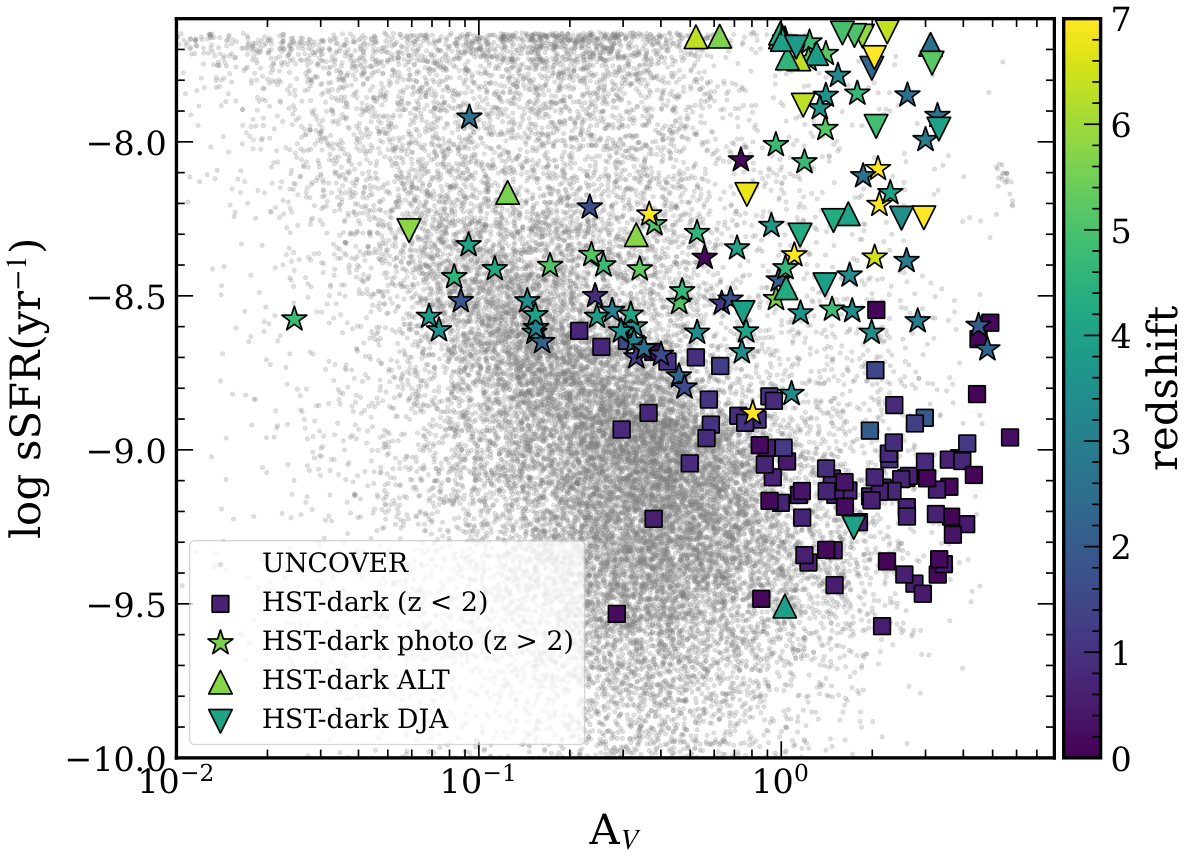
Figure 5: Distribution of HST-dark galaxies in the dust attenuation (A_V) vs plane. Grey points represent all the UNCOVER survey galaxies. The stars, upper and lower triangle markers, represent the high redshift (z>2) galaxies. The low redshift (z<2) HST-dark galaxies are marked with squares. HST-dark galaxies are colored according to their redshift. HST-dark galaxies with z<2 have high dust content and lower sSFR than the HST-dark galaxies with z>2.
V Results and Discussion
V.1 Properties of HST-dark Galaxies
With the unprecedented sensitivity of JWST/NIRCam, and by combining data in broad-band filters with the MegaScience medium-band filters, we can now accurately constrain the photometric redshift and the SEDs of the HST-dark galaxies. We can, for the first time, derive the physical parameters, such as stellar masses, SFR, and dust content, of these galaxies more reliably than the previous studies with IRAC-selected sources. We will now discuss the physical properties of the HST-dark galaxies derived from the BAGPIPES SED fitting (see Figure 6).
Our analysis suggests that HST-dark galaxies are not a homogeneous sample and include diverse galaxies spanning a range of redshifts, stellar masses, and SFRs. By their very nature, the vast majority of HST-dark galaxies reside at redshifts z>3. Recent discoveries utilising JWST have confirmed their presence well into the Epoch of Reionisation at z∼ 6-8 (5; 59), whereas the previous surveys of HST-dark galaxies with Spitzer were limited to z<6. The median redshift of our final sample of HST-dark galaxies is 4.03. We have 12 galaxies with z>6. The number of HST-dark galaxies increases rapidly with redshift up to z∼ 3, then decreases gradually (see top left panel of Figure 6).
Our analysis confirms that the HST-dark population is far more diverse than the massive (), infrared-bright starbursts identified in early HST, Spitzer surveys (80). Moreover, the population encompasses a remarkably broad mass range. Previous JWST surveys reveal distributions spanning () with median values around 10¹⁰ M_⊙ (5; 59; 83; 4). Furthermore, JWST data have uncovered a population of High-Extinction, Low-Mass (HELM) galaxies similar to the HST-dark galaxies with z<2 in our sample that extend this distribution down to (), proving that strong dust obscuration is not exclusively tied to the highest-mass systems in the early Universe (7; 8). While our sample includes massive systems () consistent with those found by 5; 59, it also reveals a significant population of lower-mass galaxies (). Our sample resides in the regime of with a median value of , representing a class of galaxies that were previously missing even to early JWST surveys like CEERS having sensitivity lower than UNCOVER.
We find that these galaxies have a range of dust content, with 75% having V-band attenuation values A_V>0.3 mag. In the SED modelling, we allowed A_V to vary from 0 to 6. However, the dust attenuation reaches only up to 5, with only 2 galaxies having A_V above 4, similar to 5. For our sample, the median dust attenuation is 0.99 mag. Because of the extreme depth and lensing nature of the UNCOVER survey, we are, for the first time, seeing the low-mass, less dusty population of HST-dark galaxies.
Our sample also exhibits a broad range of SFRs, from low SFR galaxies (SFR∼ 0.1 M_⊙ yr⁻¹) to intense starbursts having (SFR>100 M_⊙ yr⁻¹). Not all of the red sources are actively forming stars; high-resolution spectroscopy has revealed that a substantial fraction (roughly 13–18%) are actually massive quiescent galaxies that rapidly quenched very early (59; 4). More than 75% of our HST-dark galaxies have SFR<10 M_⊙ yr⁻¹ with a median value of 4.13 M_⊙ yr⁻¹. The fact that these low-mass, dusty galaxies contribute so substantially to the overall stellar mass budget at z>3 suggests that the “missing” part of the cosmic SFRD is not just in the most massive galaxies, but is spread across the mass function. This implies that the transition from “UV-bright” to “dust-obscured” occurs at lower stellar masses than previously predicted seen, potentially requiring a revision of how we model feedback and metal enrichment in the first few billion years of cosmic time (see also V.5).
Figure 6: Histogram of the redshift (upper left), stellar mass (upper right), SFR (lower left), and dust attenuation (lower right) of HST-dark (z>2) galaxies. The respective median values are shown with red lines. The histogram shows the high redshift nature of these galaxies and spans a range of stellar mass, SFR, and dust.
V.2 Star Forming Main Sequence
The bulk of star-forming galaxies assemble their stellar mass through a secular, steady process, which places them along a tight correlation between SFR and stellar mass known as the Star-Forming Main Sequence (SFMS). Determining where optically faint or HST-dark galaxies lie relative to this sequence is crucial for understanding whether they represent normal galaxy growth or extreme, episodic events in the early Universe. To characterise the evolutionary state of our sample, we place our sample of HST-dark galaxies on the stellar mass versus SFR (–SFR) plane (see Figure 7). To compare our results with the previous studies of dusty galaxies, we have plotted the ALESS SMGs (27) and HST-dark galaxies selected from Spitzer (80) and JWST (5). Our sample spans a wide range of physical properties, with SFRs extending from relatively quiescent levels (∼ 0.06 M_⊙ yr⁻¹) to extreme starbursts exceeding ∼ 900 M_⊙ yr⁻¹ (mean SFR≈ 35.3 M_⊙ yr⁻¹). When compared to the established SFMS at z∼ 4 (67), the majority of our sources lie squarely within the expected scatter of the sequence, as also seen by 5. This suggests that the “optically dark” nature of these galaxies is not necessarily a sign of exotic, off-sequence starburst activity, but rather a ubiquitous phase of typical galaxy growth that is simply obscured by dust.
The integration of UNCOVER ultra-deep imaging with MegaScience medium-bands enables us to trace the SFMS into a regime previously inaccessible to legacy surveys. The previous Spitzer/IRAC and SMG studies (27; 80) were largely restricted to massive systems (). This demonstrates that previous surveys systematically missed the lower-mass end of the obscured main sequence and were heavily biased toward only the brightest and most massive obscured galaxies. Even with earlier JWST surveys like CEERS, the HST-dark galaxy sample was limited to (5; 59). However, our sample probes nearly two orders of magnitude lower in stellar mass, from 10⁹ M_⊙ down to a “dusty dwarf” regime at . This significant extension to lower masses indicates that the HST-dark phenomenon is prevalent even in small mass galaxies at early cosmic epochs.
Comparing our findings to classic Submillimeter Galaxies (SMGs), which typically represent the high-SFR (SFR ∼ 10³ M_⊙ yr⁻¹) outliers of the SFMS, we find that our UNCOVER-selected sample captures the dust obscured population with four orders of magnitude lower stellar mass and SFR. By accounting for these sources across the z≈ 2-8 range, we provide a more complete census of the stellar mass (up to log(M_∗/M_⊙)∼ 7.0) and SFR budget over this redshift range.
Figure 7: Star-forming main sequence (SFR against stellar mass) is shown. Our sample of HST-dark galaxies is shown with blue stars, meganta upper triangles, and green lower triangles. The HST-dark sample from the 5 is shown with yellow squares. Spitzer-selected optically dark galaxies from 80 are represented by cyan circles. SMGs are shown with red hexagons from 27. Our sample of HST-dark galaxies probes a lower stellar mass and lower SFR region of the MS plot not seen before.
V.3 Dust attenuation
A defining characteristic of the HST-dark population is the significant attenuation of rest-frame ultraviolet and optical light by interstellar dust. In our sample, we find a broad distribution of V-band attenuation, ranging from nearly transparent (A_V ≈ 0.02) to heavily obscured (A_V ≈ 4.80), with a mean value of A_V=1.14. Interestingly, we find that the galaxies at the lower end of the dust distribution are characteristically low in both stellar mass and SFR. These sources are HST-dark, not due to extreme dust obscuration, but because even moderate dust columns compound their intrinsic faintness from low mass and low SFR. This combination of factors pushes them below the HST detection limit.
To distinguish between dusty star formation and quiescence across this diverse sample, we utilise the rest-frame U-V versus V-J (UVJ) color-color diagnostic (see Figure 8). The UVJ diagram is critical to break the degeneracy between age and dust. Our sample primarily populates the dusty and non-dusty star-forming region, similar to the sample of 5. The galaxies with both low (<0.5) U-V and V-J were not previously seen (5; 59). We can also see three galaxies in the quiescent region of the UVJ diagram, and we have spectroscopic redshifts for all of them (3.69, 3.96, and 3.99), one from ALT and two from DJA. Their existence is consistent with the claim of 59 that quiescent galaxies at z<3 do not satisfy the HST-dark color cut. The spectrum of one of the quiescent galaxies is shown in the Appendix C. We can see that the spectrum is red, with no lines except for a weak Hα line. This confirms that the “HST-dark” nature of our targets is predominantly driven by a combination of SFR and dust reddening. This broad distribution in A_V and UVJ color within our sample suggests a diverse range of dust geometries and birth-cloud environments across the z≈ 2 to 8 range.
Table 2: Comparison of median redshift and dust attenuation.
| Sample Source | Median Redshift (z) | Median Attenuation (A_V) |
|---|---|---|
| HST-dark (UNCOVER; this work) | 4.03 | 0.99 |
| HST-dark (5, CEERS;) | 4.41 | 2.06 |
| SMGs (27) | 2.83 | 2.10 |
When comparing our results with SMGs and previous JWST studies, we see a clear hierarchy in the optically dark galaxies (see Figure 9 and Table 2). Our sample sits at a significantly higher redshift (median z≈ 4.0) and lower dust attenuation (median A_V ≈ 1.0) compared to classical SMGs (median z≈ 3.0 and A_V ≈ 2.0). Our sample reaches similar high-redshift territory as the 5 sample (median z≈ 4.4 and A_V ≈ 2.0) but with a notably lower A_V.
This highlights the unique discovery space of the UNCOVER survey. While 5 primarily identified the “classical” HST-dark galaxies (massive and dusty), our sample allows us to detect a “fainter” dark population. These galaxies are HST-dark not necessarily because they possess extreme dust (A_V>1), but because their moderate dust content is sufficient to push their already faint, high-redshift flux below the detection limits of HST. This moderately dusty population, missing from both SMG and previous HST-dark samples, represents a crucial link in understanding the transition from the UV-bright to the dust-obscured phase of galaxy evolution.
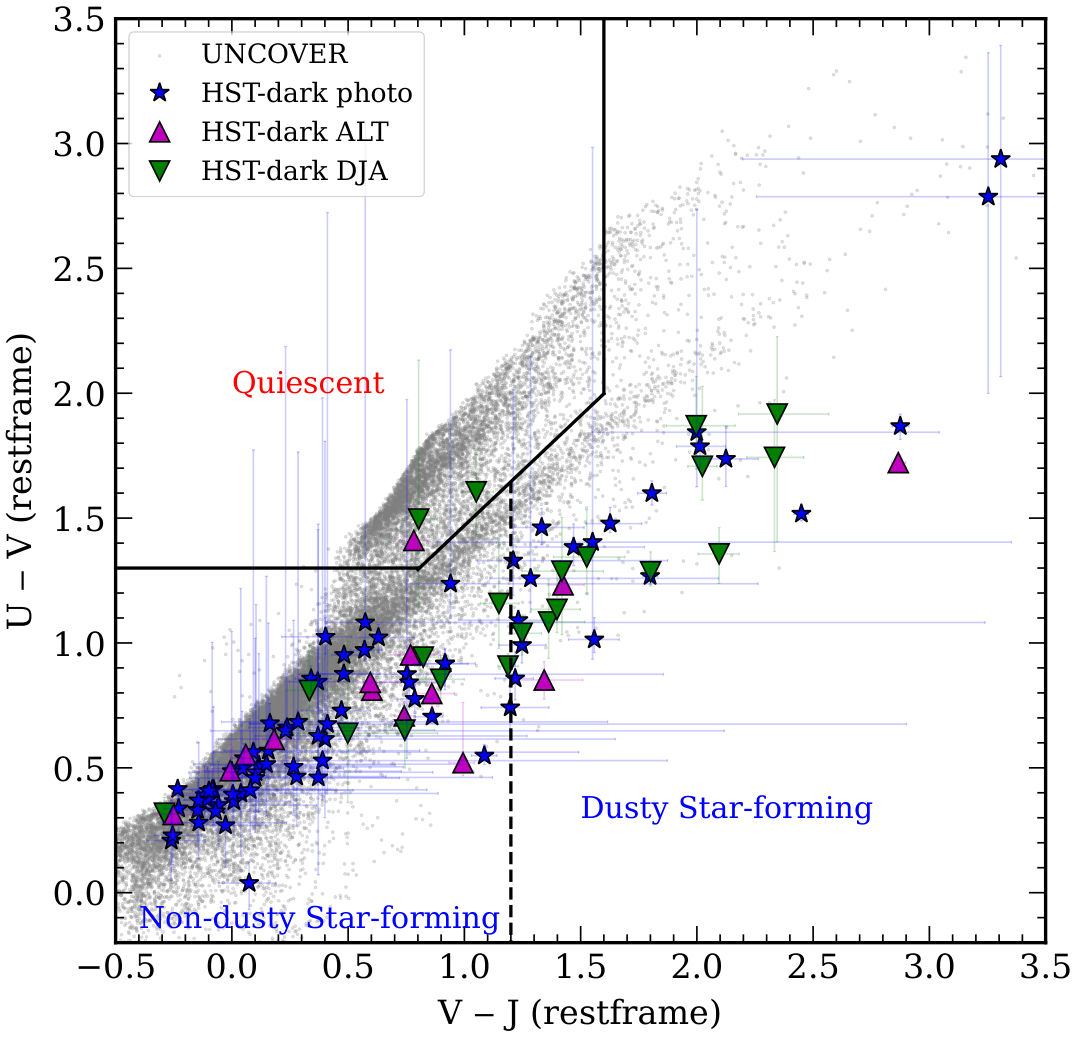
Figure 8: UV vs VJ rest frame color-color diagram is shown. Our sample of HST-dark galaxies is shown with blue stars, magenta upper triangles, and green lower triangles. All the UNCOVER galaxies are shown with grey points. The black dashed and solid lines are from 69 separating quiescent, dusty, and non-dusty star-forming galaxies. Our sample spans a range of UV and VJ colors, with almost all galaxies being star-forming. We also have three quiescent galaxies in our sample. However, given the uncertainties of the colors, there could be more galaxies in the quiescent region. Spectrum of one of the quiescent galaxies is shown in Appendix C.
Figure 9: Dust attenuation (A_V) against redshift is represented. As in the previous figures, our sample of HST-dark galaxies is shown with blue stars, magenta upper triangles, and green lower triangles. SMGs are shown with red hexagons (27). HST-dark galaxies from CEERS are shown with yellow squares (5). HST-dark galaxies, on average, have lower dust content and are at a higher redshift than SMGs. Our sample probes a lower A_V compared to both SMGs and HST-dark galaxies from CEERS.
V.4 Size-Mass Relation
Table 3: Median r₈₀ for the HST-dark and UNCOVER Populations (3<z<5).
| Mass Bin [log()] | N_UNCOVER | Median r_[80,UNCOVER] [kpc] | N_HST-dark | Median r_[80,HST-dark] [kpc] |
|---|---|---|---|---|
| 7-8 | 833 | 1.47± 0.03 | 9 | 1.30± 0.17 |
| 8-9 | 870 | 2.10± 0.03 | 16 | 1.57± 0.33 |
| 9-10 | 192 | 2.99± 0.16 | 14 | 2.23± 0.56 |
| 10-11 | 15 | 4.00± 0.32 | 11 | 2.36± 0.48 |
To investigate the morphological nature of the HST-dark population, we perform a structural analysis using statmorph (65), a Python-based code for computing non-parametric morphology parameters. We adopt the 80% light radius (r₈₀, an output from statmorph) as our primary measure of galaxy size. We compare r₈₀ of our HST-dark sample against the broader UNCOVER population within the redshift range 3<z<5. Our results reveal a clear and systematic offset in the Size–Mass relation over four orders of magnitude in stellar mass. HST-dark galaxies are consistently smaller in size than the UV-bright galaxies (see Figure 10), and the difference in size increases with the stellar mass.
At the lower-mass end (), the median r₈₀ for the general UNCOVER population is ∼ 1.47 kpc. In contrast, the HST-dark exhibit a smaller median size of ∼ 1.30 kpc. This trend continues into the high-mass regime (), where the difference becomes even more pronounced. HST-dark galaxies have median sizes of ∼ 2.36 kpc, nearly 40% smaller than the ∼ 4.00 kpc median observed for the broader population in the same mass bin (see Table 3).
The observed smaller sizes of these galaxies suggest that star formation in the HST-dark population is occurring in extremely dense environments. In a “bottom-up” assembly scenario, these compact, dusty systems likely represent the rapid formation of stellar bulges. The high dust attenuation and small r₈₀ values indicate that these galaxies are efficiently converting gas into stars within centralised regions, potentially leading to the formation of the bulge components seen in modern-day massive galaxies.
Furthermore, the fact that this compactness is maintained down to the 10⁸ M_⊙ mass regime suggests that the “dark” nature of these galaxies is intrinsically tied to their structural density. In these compact halos, the gas and dust are concentrated enough to produce significant obscuration even at relatively low total dust masses. This structural evidence supports the idea that the HST-dark population represents a critical, high-density phase of galaxy evolution that is fundamentally different from the more extended, UV-bright star-forming galaxies typically identified at these redshifts.
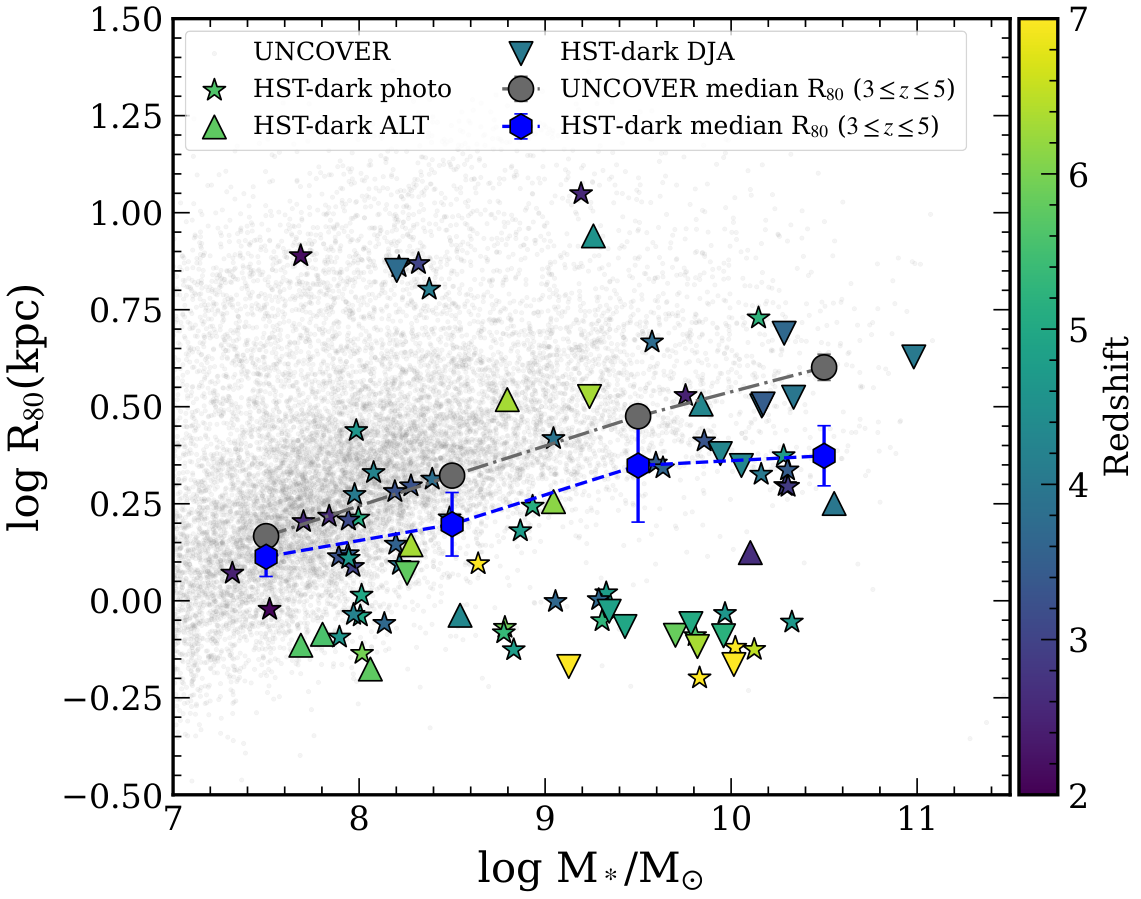
Figure 10: Size (R₈₀) plotted as a function of stellar mass. Grey points represent all the UNCOVER galaxies. Our sample of HST-dark galaxies is shown with stars and upper and lower triangles, colored by redshift. Median sizes in different stellar mass bins are also shown for the UNCOVER (grey circles) and HST-dark (blue hexagon) galaxies with 3≤z≤5. The error bars in the median values are standard deviations in the bootstrap median distribution with 2000 realisations. HST-dark galaxies are smaller in size than the typical UV-bright galaxies in all stellar mass bins.
V.5 Cosmic Star Formation Rate Density (SFRD)
Tracing the cosmic star formation rate density (CSFRD) over time is fundamental to understanding the cosmic SFH (51), the galaxy mass assembly, and the metal enrichment history of the Universe. Historically, estimates of the SFRD at z>3 were heavily relied on UV-selected galaxies (9; 10), predominantly Lyman-break galaxies (LBGs). However, as UV emission is highly susceptible to dust attenuation, these rest-frame UV samples are systematically biased against massive, dust-obscured, star-forming galaxies. Consequently, excluding these optically faint sources from censuses of star formation inevitably leads to a significant, redshift-dependent underestimation of the true total CSFRD (22).
The study of HST-dark galaxies and SMGs has revealed that a significant portion of the cosmic SFH has been hidden. At z=4-5, 79 estimated that these sources contribute about 15%-25% to the CSFRD. 83 investigated the contribution of optically faint galaxies (OFGs) excluding LBGs to the CSFRD and found that at z>3, massive OFGs contribute to CSFRD at least two orders of magnitude higher than the similarly massive LBGs. They have also found that at z=4-5, the combined contribution of LBGs and OFGs is 43% higher than the UV-selected samples to CSFRD. Furthermore, JWST observations from CEERS have shown that the contribution of HST-dark galaxies to the CSFRD remains relatively constant from z∼ 4 all the way up to z∼ 7 (5). This is a critical finding because the contribution of classical submillimeter galaxies rapidly drops off at z>5 (27; 54). Extrapolations of radio-selected near-infrared-faint galaxies even suggest that their contribution to the total CSFRD could equal that of UV-bright galaxies at z∼ 4 (38), confirming that tracing this population is absolutely pivotal for achieving a complete map of early galaxy evolution.
Table 4: SFRD for the HST-dark Galaxy Sample.
| Redshift (z) | SFRD [10⁻³ M_⊙ yr⁻¹ Mpc⁻³] | N |
|---|---|---|
| 2.5 | 3.65⁺¹.⁵¹₋₁.₁₃ | 17 |
| 3.5 | 2.34⁺¹.⁶⁰₋₀.₅₅ | 36 |
| 4.5 | 9.89⁺⁶.⁹³₋₄.₃₄ | 30 |
| 5.5 | 4.00⁺¹.⁴⁸₋₁.₁₉ | 18 |
| 6.5 | 1.97⁺¹.¹⁰₋₀.₇₅ | 7 |
| 7.5 | 1.94⁺¹.¹⁷₋₀.₇₂ | 5 |
Figure 11: SFRD vs redshift is depicted for the HST-dark sample of ours (blue circles). SFRD of various previous studies of SMGs and HST-dark galaxies is shown as well. The orange area is the dust-obscured SFH derived from semi-empirical models by 84. The dust-unobscured SFH is shown in blue, based on 11. We have extended the SFRD estimation for HST-dark galaxies till z=8. The SFRD estimated from our sample is somewhat higher than that from previous optically dark galaxy samples, except in the redshift bin 4-5, where it is even higher.
To quantify the contribution of our sample to the cosmic star formation budget, we calculate the CSFRD (ρ_SFR) across six redshift bins spanning z=2 to z=8. The SFRD is determined by summing the individual galaxy SFRs within each redshift bin and normalising by the comoving volume. The volume is calculated based on our survey area and a standard ΛCDM cosmology. Asymmetric 1σ uncertainties are derived by combining the Poissonian errors of the galaxy counts, following the frequentist approach for small sample sizes described by 37, with the individual SFR measurement uncertainties propagated in quadrature.
Our results, summarised in Table 4, reveal a significant and dynamic evolution of the obscured star formation density. We find that the CSFRD peaks prominently at z≈ 4.5 with a value of 9.89⁺⁶.⁹³₋₄.₃₄ × 10⁻³ M_⊙ yr⁻¹ Mpc⁻³. This peak is notably higher than the CSFRD observed in the adjacent bins (z=3.5 and z=5.5), suggesting that the epoch around z∼ 4.5 represents a period of intense, dust-shrouded galaxy assembly (see Figure 11).
This finding provides an interesting comparison to the results of 5. While their analysis of the CEERS field suggested a relatively constant contribution from HST-dark galaxies to the CSFRD from z∼ 4 to z∼ 7, our sample—leveraging the increased depth of UNCOVER and the lensing magnification of the cluster—reveals a more punctuated evolution. Specifically, the sharp increase at z∼ 4.5 suggests that the “optically dark” phase may be more prevalent at specific cosmic epochs than previously recognised, potentially driven by the rapid evolution and dust-enrichment of the lower-mass galaxy population () that dominates our sample.
Furthermore, our data confirms the presence of obscured star formation into the Epoch of Reionisation. At z=6.5 and z=7.5, we find SFRD values of 1.97× 10⁻³ and 1.53× 10⁻³ M_⊙ yr⁻¹ Mpc⁻³, respectively. While the contribution of classical, massive SMGs is known to drop precipitously beyond z>5 (27), our detection of these intrinsically fainter HST-dark sources indicates that dust-obscured star formation remains a non-negligible component of the total stellar mass assembly budget even at these early times (see Figure 11). This reinforces the necessity of additional ultra-deep JWST observations to capture the full star-forming census, as these “dusty dwarfs” provide a vital link between the early UV-bright population and the massive, obscured systems observed at cosmic noon. However, we caution that as our analysis is confined to the single JWST field, the observed CSFRD evolution, particularly the sharp peak at z≈ 4.5, may be influenced by cosmic variance or localised overdensities. Expanding this study across multiple, independent deep JWST surveys will be crucial to average out these effects and establish a truly global census of this obscured population.
VI Summary and Conclusion
Here, we present a comprehensive analysis of 113 high-redshift (z>2) and 94 low-redshift (z<2) HST-dark galaxies identified within the ultra-deep JWST UNCOVER and MegaScience surveys of the Abell 2744 field. By leveraging the unprecedented sensitivity of NIRCam broad-band and medium-band imaging, along with the magnification provided by the foreground cluster, we have probed a previously hidden population of galaxies. Our findings challenge the traditional view that the “optically dark” universe is exclusively populated by massive, star-forming galaxies. The primary conclusions of this work are summarised below.
- Our primary sample of HST-dark galaxies at z>2 reaches the “dusty dwarf” regime with a median stellar mass of , unlike previous Spitzer-selected samples that were limited to the high-mass regime (). This demonstrates that significant dust obscuration is a prevalent feature across a wide range of stellar masses at high redshift.
- We find a median dust attenuation of A_V=0.99, which is significantly lower than the values reported for classical SMGs or more massive HST-dark samples (A_V ≳ 2.0). This reveals that these galaxies are “dark” to Hubble, not necessarily due to extreme dust columns, but because their intrinsic faintness (low mass and low SFR) combined with moderate dust, which is sufficient to suppress their rest-frame UV and optical flux below the HST detection limit.
- Our sample sits squarely on the Star-Forming Main Sequence. This indicates that HST-dark galaxies are not short-lived, exotic outliers, but represent a typical but obscured phase of galaxy assembly.
- Size-mass analysis reveals that HST-dark galaxies are systematically smaller in size than the UV-bright galaxies across all mass bins. Their lower r₈₀ values suggest that star formation in these sources occurs in high-density environments, making them potential progenitors of the central bulges seen in massive galaxies today.
- Our calculated SFRD shows a prominent peak at z≈ 4.5 (9.89⁺⁶.⁹³₋₄.₃₄ × 10⁻³ M_⊙ yr⁻¹ Mpc⁻³). The persistence of these obscured galaxies into the Epoch of Reionisation (z>6) confirms that a substantial portion of the early stellar mass assembly has been systematically underestimated in UV-only surveys.
- We also identified a distinct sub-population of optically dark sources at z<2 (median z≈ 0.76) that exhibit properties remarkably similar to the HELM galaxies recently identified and characterised with JWST. In our sample, these galaxies are extremely low-mass (median ) and disproportionately dusty, with a median attenuation of A_V ≈ 1.97 mag, which is significantly higher than that of our high-redshift sample. These galaxies are characterised by extremely low SFRs (median SFR≈ 0.009 M_⊙ yr⁻¹) and broad photometric redshift posterior distributions.
The diversity of our HST-dark sample, ranging from compact, massive star-forming galaxies at cosmic noon to extremely dusty dwarfs at z<1, underscores the complexity of dust enrichment and galaxy assembly across cosmic time. Our findings, particularly the prominent peak in the SFRD at z≈ 4.5, suggest that a substantial portion of the dust-obscurved star-formation in the early universe has been missed by previous surveys. Collectively, our results suggest that dust production occurs rapidly and efficiently even in low-mass galaxies, and that the transition to a dust-obscured interstellar medium is a fundamental evolutionary stage that begins earlier and at lower mass scales than previously seen. To mitigate the impact of cosmic variance and confirm the global significance of these findings, it will be imperative to extend such ultra-deep multi-band observations to additional JWST surveys. Future spectroscopic follow-up with JWST/NIRSpec will also be essential to confirm the photometric redshifts and characterise the metallicities and gas-phase kinematics of these galaxies.
The authors acknowledge the support of the Department of Atomic Energy, Government of India, under project no. 12-R&D-TFR5.02-0700. We are grateful to the UNCOVER and MegaScience teams for designing their observing programs, developing data-reduction pipelines, and providing reduced data products to the public. This work is based on observations made with the NASA/ESA/CSA James Webb Space Telescope and the NASA/ESA Hubble Space Telescope. The data were obtained from the Mikulski Archive for Space Telescopes at the Space Telescope Science Institute, which is operated by the Association of Universities for Research in Astronomy, Inc., under NASA contract NAS 5-03127 for JWST and NAS 5-26555 for HST. These observations are associated with JWST Cycle 1 GO program 2561 and Cycle 2 GO program 4111, and gratefully made use of additional public JWST programs in the Abell 2744 field, including JWST-ERS-1324, JWST-DD-2756, JWST-GO-2641, JWST-GO-2883, JWST-GO-3516, and JWST-GO-3538. The relevant HST observations are associated with programs HST-GO-11689, HST-GO-13386, HST-GO-13389, HST-GO/DD-13495, HST-GO-15117, and HST-GO/DD-17231. Some of the data products presented herein were retrieved from the Dawn JWST Archive (DJA). DJA is an initiative of the Cosmic Dawn Center (DAWN), which is funded by the Danish National Research Foundation under grant DNRF140.
Appendix A HST-dark sample (z>2)
See Table [5](#A1.T5 "Table 5 ‣ Appendix A HST-dark sample (
        >
        z
        2


  ) ‣ Optically Invisible Galaxies at Cosmic Noon and beyond with JWST/UNCOVER") for the properties of the HST-dark galaxies (z>2). The spectroscopic samples from ALT and DJA are given in Tables [6](#A1.T6 "Table 6 ‣ Appendix A HST-dark sample (


        >
        z
        2


  ) ‣ Optically Invisible Galaxies at Cosmic Noon and beyond with JWST/UNCOVER") and [7](#A1.T7 "Table 7 ‣ Appendix A HST-dark sample (


        >
        z
        2


  ) ‣ Optically Invisible Galaxies at Cosmic Noon and beyond with JWST/UNCOVER"). For more information, see Sections [II](#S2 "II Data and Sample Selection ‣ Optically Invisible Galaxies at Cosmic Noon and beyond with JWST/UNCOVER") and [III](#S3 "III Stellar Population Synthesis (SPS) and redshift distribution ‣ Optically Invisible Galaxies at Cosmic Noon and beyond with JWST/UNCOVER") for our sample selection and SPS fitting with BAGPIPES.
Table 5: Properties of HST-dark galaxies (z>2)
| ID_DR3 | ra (deg) | dec (deg) | z | logSFR (M_⊙ yr⁻¹) | U–V (mag) | V–J (mag) | Av (mag) | r80 (arcsec) | |
|---|---|---|---|---|---|---|---|---|---|
| 508 | 3.6153722 | -30.4658274 | 5.62⁺⁰.¹³₋₀.₀₇ | 9.81⁺⁰.⁰⁶₋₀.₀₈ | 1.30⁺⁰.¹⁰₋₀.₁₀ | 0.95⁺⁰.⁰³₋₀.₀₃ | 0.48⁺⁰.⁰⁶₋₀.₀₅ | 0.96⁺⁰.⁰⁹₋₀.₀₉ | 0.13 |
| 1171 | 3.6169204 | -30.4630031 | 5.27⁺⁰.⁰⁹₋₀.₀₈ | 9.31⁺⁰.²¹₋₀.₁₂ | 1.50⁺⁰.³⁴₋₀.₁₄ | 0.86⁺⁰.¹¹₋₀.₀₉ | 1.22⁺⁰.⁰⁸₋₀.₀₉ | 1.40⁺⁰.³¹₋₀.₁₅ | 0.14 |
| 2506 | 3.6270847 | -30.4578844 | 7.94⁺⁰.²³₋₀.₃₁ | 9.83⁺⁰.¹⁵₋₀.₁₃ | 1.76⁺⁰.²⁹₋₀.₂₅ | 1.38⁺⁰.⁰⁹₋₀.₀₇ | 1.47⁺⁰.³¹₋₀.₂₅ | 2.09⁺⁰.³³₋₀.₂₇ | 0.13 |
| 4634 | 3.6230042 | -30.4500143 | 2.95⁺⁰.²³₋₀.₂₀ | 10.29⁺⁰.¹²₋₀.₁₇ | 2.30⁺⁰.²⁴₋₀.₅₀ | 1.74⁺⁰.¹³₋₀.₁₁ | 2.12⁺⁰.¹⁴₋₀.₁₀ | 3.00⁺⁰.²⁰₋₀.₅₀ | 0.25 |
| 6954 | 3.5946059 | -30.4420220 | 4.78⁺⁰.⁰³₋₀.₀₅ | 9.33⁺⁰.⁰³₋₀.₀₃ | 1.64⁺⁰.⁰³₋₀.₀₄ | 0.70⁺⁰.⁰³₋₀.₀₃ | 0.86⁺⁰.⁰⁵₋₀.₀₇ | 1.24⁺⁰.⁰⁴₋₀.₀₅ | 0.16 |
| 7867 | 3.5691162 | -30.4386690 | 3.51⁺⁰.⁵⁸₋₂.₃₅ | 7.94⁺⁰.¹⁷₋₀.₅₇ | -0.61⁺⁰.²⁴₋₀.₈₉ | 0.51⁺⁰.⁴⁵₋₀.₁₉ | 0.12⁺⁰.⁵⁹₋₀.₂₁ | 0.33⁺⁰.⁴⁷₋₀.₁₈ | 0.18 |
| 8128 | 3.5671172 | -30.4380087 | 3.81⁺⁰.²⁴₋₀.₄₃ | 8.39⁺⁰.¹⁰₋₀.₁₄ | -0.20⁺⁰.¹⁶₋₀.₁₆ | 0.39⁺⁰.¹²₋₀.₁₁ | -0.12⁺⁰.¹⁸₋₀.₁₁ | 0.15⁺⁰.¹⁵₋₀.₁₁ | 0.28 |
| 9248 | 3.6207043 | -30.4351901 | 2.49⁺².⁰²₋₀.₆₄ | 9.75⁺⁰.⁵⁷₋₀.₄₀ | 1.01⁺¹.⁰⁵₋₀.₅₁ | 2.79⁺⁰.⁵⁸₋₀.₇₉ | 3.25⁺⁰.⁷³₋₁.₀₀ | 4.49⁺⁰.⁹⁶₋₁.₃₃ | 0.41 |
| 10708 | 3.6439445 | -30.4314827 | 3.45⁺⁰.²¹₋₁.₆₂ | 9.60⁺⁰.¹⁵₋₀.₂₉ | 1.06⁺⁰.³⁷₋₀.₆₁ | 1.33⁺⁰.⁶⁸₋₀.₁₄ | 1.21⁺⁰.⁶⁶₋₀.₁₆ | 1.72⁺⁰.⁹²₋₀.₃₄ | 0.30 |
| 10729 | 3.5864273 | -30.4313678 | 3.56⁺⁰.¹¹₋₀.₁₈ | 8.20⁺⁰.⁰⁶₋₀.₁₀ | -0.41⁺⁰.¹²₋₀.₀₈ | 0.32⁺⁰.⁰⁶₋₀.₀₇ | -0.26⁺⁰.⁰⁵₋₀.₀₄ | 0.07⁺⁰.⁰⁸₋₀.₀₅ | 0.19 |
Table 6: Properties of HST-dark galaxies (z>2) with spectroscopic redshift from ALT survey
| ID_DR3 | ra (deg) | dec (deg) | z | logSFR (M_⊙ yr⁻¹) | U–V (mag) | V–J (mag) | Av (mag) | r80 (arcsec) | |
|---|---|---|---|---|---|---|---|---|---|
| 11682 | 3.5675211 | -30.4287359 | 5.76 | 8.06⁺⁰.¹⁴₋₀.₂₁ | -0.20⁺⁰.¹⁷₋₀.₁₄ | 0.49⁺⁰.¹¹₋₀.₁₀ | -0.01⁺⁰.¹³₋₀.₁₃ | 0.33⁺⁰.¹³₋₀.₁₃ | 0.11 |
| 12602 | 3.5894544 | -30.4261916 | 6.12 | 9.05⁺⁰.⁰⁴₋₀.₀₃ | 1.38⁺⁰.⁰³₋₀.₀₃ | 0.81⁺⁰.⁰⁴₋₀.₀₄ | 0.60⁺⁰.⁰⁵₋₀.₀₅ | 0.99⁺⁰.⁰⁵₋₀.₀₄ | 0.31 |
| 13415 | 3.5754719 | -30.4244692 | 4.02 | 9.43⁺⁰.⁰⁸₋₀.₀₈ | 1.19⁺⁰.²²₋₀.₁₄ | 1.23⁺⁰.⁰⁴₋₀.₀₄ | 1.42⁺⁰.⁰⁹₋₀.₀₆ | 1.67⁺⁰.²⁵₋₀.₁₀ | 0.78 |
| 15465 | 3.5759869 | -30.4190294 | 3.83 | 8.01⁺⁰.⁰⁸₋₀.₀₇ | 0.28⁺⁰.⁰⁷₋₀.₀₇ | 0.85⁺⁰.⁰⁷₋₀.₀₈ | 1.34⁺⁰.¹⁷₋₀.₁₄ | 1.31⁺⁰.¹²₋₀.₁₂ | 0.11 |
| 15610 | 3.5987977 | -30.4187332 | 4.32 | 8.54⁺⁰.³⁰₋₀.₀₄ | 0.88⁺⁰.³¹₋₀.₀₄ | 0.52⁺⁰.²⁴₋₀.₀₅ | 0.99⁺⁰.⁰⁵₋₀.₀₆ | 0.99⁺⁰.³²₋₀.₀₆ | 0.13 |
| 21839 | 3.6124251 | -30.4056651 | 6.33 | 8.80⁺⁰.⁰⁵₋₀.₀₅ | 1.06⁺⁰.⁰⁵₋₀.₀₆ | 0.80⁺⁰.⁰⁶₋₀.₀₆ | 0.86⁺⁰.¹⁰₋₀.₀₇ | 1.14⁺⁰.⁰⁶₋₀.₀₆ | 0.58 |
| 21888 | 3.6112710 | -30.4054001 | 6.32 | 8.28⁺⁰.⁰⁴₋₀.₀₃ | 0.62⁺⁰.⁰⁴₋₀.₀₄ | 0.55⁺⁰.⁰³₋₀.₀₃ | 0.06⁺⁰.⁰⁶₋₀.₀₅ | 0.52⁺⁰.⁰⁴₋₀.₀₄ | 0.25 |
| 27716 | 3.6175093 | -30.3953555 | 4.58 | 9.26⁺⁰.⁰⁵₋₀.₀₃ | 1.53⁺⁰.⁰⁴₋₀.₀₇ | 0.71⁺⁰.⁰⁶₋₀.₀₆ | 0.74⁺⁰.⁰⁵₋₀.₀₄ | 1.05⁺⁰.⁰⁴₋₀.₀₄ | 1.30 |
| 35257 | 3.5353067 | -30.3810088 | 5.66 | 7.69⁺⁰.⁰⁶₋₀.₀₅ | 0.03⁺⁰.⁰⁵₋₀.₀₅ | 0.61⁺⁰.⁰⁵₋₀.₀₅ | 0.18⁺⁰.⁰⁹₋₀.₀₇ | 0.63⁺⁰.⁰⁷₋₀.₀₆ | 0.13 |
| 35891 | 3.5920965 | -30.3804717 | 2.65 | 10.10⁺⁰.⁰³₋₀.₀₂ | 2.42⁺⁰.⁰²₋₀.₀₃ | 1.72⁺⁰.⁰⁴₋₀.₀₄ | 2.87⁺⁰.⁰³₋₀.₀₃ | 3.12⁺⁰.⁰⁵₋₀.₀₅ | 0.16 |
Table 7: Properties of HST-dark galaxies (z>2) with spectroscopic redshift from DJA
| ID_DR3 | ra (deg) | dec (deg) | z | logSFR (M_⊙ yr⁻¹) | U–V (mag) | V–J (mag) | Av (mag) | r80 (arcsec) | |
|---|---|---|---|---|---|---|---|---|---|
| 13416 | 3.5755647 | -30.4243802 | 4.02 | 10.98⁺⁰.¹⁰₋₀.₁₂ | 2.96⁺⁰.³⁵₋₀.₅₆ | 1.92⁺⁰.⁰⁶₋₀.₀₄ | 2.35⁺⁰.²²₋₀.₁₇ | 3.32⁺⁰.³¹₋₀.₅₁ | 0.60 |
| 13742 | 3.6192037 | -30.4232716 | 5.84 | 9.70⁺⁰.¹¹₋₀.₁₁ | 2.03⁺⁰.¹¹₋₀.₁₁ | 1.08⁺⁰.⁰⁸₋₀.₀₇ | 1.36⁺⁰.¹⁶₋₀.₁₃ | 1.86⁺⁰.¹⁷₋₀.₁₅ | 0.14 |
| 20698 | 3.5567049 | -30.4081918 | 2.42 | 9.37⁺⁰.⁰⁷₋₀.₀₅ | 1.60⁺⁰.⁰⁴₋₀.₀₅ | 1.29⁺⁰.⁰⁵₋₀.₀₅ | 1.80⁺⁰.⁰³₋₀.₀₃ | 1.99⁺⁰.⁰⁸₋₀.₀₆ | 0.14 |
| 21547 | 3.5508378 | -30.4065978 | 5.06 | 9.78⁺⁰.⁰⁵₋₀.₀₈ | 2.12⁺⁰.⁰⁶₋₀.₀₈ | 1.04⁺⁰.⁰³₋₀.₀₄ | 1.25⁺⁰.⁰⁸₋₀.₀₆ | 1.75⁺⁰.⁰⁷₋₀.₀₉ | 0.14 |
| 21838 | 3.6123396 | -30.4056967 | 6.33 | 9.24⁺⁰.⁰⁷₋₀.₀₆ | 1.35⁺⁰.¹⁰₋₀.₀₉ | 0.85⁺⁰.⁰⁶₋₀.₀₆ | 0.90⁺⁰.¹⁰₋₀.₀₉ | 1.18⁺⁰.¹⁰₋₀.₀₈ | 0.59 |
| 24175 | 3.5798316 | -30.4015692 | 7.04 | 10.01⁺⁰.⁰⁹₋₀.₀₈ | 1.78⁺⁰.²²₋₀.₁₆ | 1.87⁺⁰.⁰⁵₋₀.₀₅ | 2.00⁺⁰.¹⁷₋₀.₁₃ | 2.96⁺⁰.²⁰₋₀.₁₇ | 0.13 |
| 24968 | 3.6206068 | -30.3999507 | 6.35 | 9.82⁺⁰.⁰⁶₋₀.₀₆ | 2.17⁺⁰.⁰⁶₋₀.₀₆ | 1.36⁺⁰.⁰⁶₋₀.₀₆ | 2.10⁺⁰.⁰⁹₋₀.₀₉ | 2.24⁺⁰.¹¹₋₀.₁₂ | 0.13 |
| 27114 | 3.5457903 | -30.3957238 | 5.20 | 9.96⁺⁰.¹⁴₋₀.₂₁ | 2.16⁺⁰.²²₋₀.₃₀ | 1.74⁺⁰.⁰⁷₋₀.₀₇ | 2.33⁺⁰.¹³₋₀.₁₂ | 3.15⁺⁰.²³₋₀.₃₈ | 0.13 |
| 27966 | 3.5972031 | -30.3943301 | 7.03 | 9.13⁺⁰.¹¹₋₀.₀₉ | 1.38⁺⁰.¹⁴₋₀.₁₄ | 1.34⁺⁰.⁰⁶₋₀.₀₆ | 1.53⁺⁰.¹⁶₋₀.₁₄ | 2.03⁺⁰.¹⁹₋₀.₁₅ | 0.13 |
| 28380 | 3.6326605 | -30.3936353 | 3.96 | 10.16⁺⁰.⁰⁶₋₀.₀₉ | 1.68⁺⁰.²⁶₋₀.₁₄ | 1.16⁺⁰.⁰⁴₋₀.₀₄ | 1.15⁺⁰.⁰⁹₋₀.₀₈ | 1.39⁺⁰.²⁵₋₀.₁₈ | 0.45 |
Appendix B HST-dark sample (z<2)
Table [8](#A2.T8 "Table 8 ‣ Appendix B HST-dark sample (
        <
        z
        2


  ) ‣ Optically Invisible Galaxies at Cosmic Noon and beyond with JWST/UNCOVER") represents the properties of the HST-dark galaxies with z<2. Also see section [IV](#S4 "IV Low redshift (


        <
        z
        2


  ) HST-dark Galaxies ‣ Optically Invisible Galaxies at Cosmic Noon and beyond with JWST/UNCOVER"), where we have discussed these low-redshift HST-dark galaxies.
Table 8: Properties of HST-dark galaxies (z<2)
| ID_DR3 | ra (deg) | dec (deg) | z | logSFR (M_⊙ yr⁻¹) | U–V (mag) | V–J (mag) | Av (mag) | r80 (arcsec) | |
|---|---|---|---|---|---|---|---|---|---|
| 987 | 3.6556036 | -30.4637311 | 0.84⁺¹.³⁴₋₀.₃₃ | 6.99⁺⁰.⁵⁵₋₀.₄₇ | -2.17⁺⁰.⁹⁸₋₀.₈₄ | 1.87⁺¹.¹⁷₋₀.₉₆ | 1.68⁺¹.⁵⁶₋₁.₁₀ | 2.17⁺².¹⁷₋₁.₄₂ | 0.05 |
| 1361 | 3.6528633 | -30.4623134 | 0.12⁺⁰.⁰⁴₋₀.₀₅ | 5.50⁺⁰.⁵⁶₋₀.₄₄ | -3.37⁺⁰.³⁶₋₀.₄₀ | 2.83⁺⁰.⁶¹₋₀.₉₇ | 2.98⁺⁰.⁸⁴₋₁.₂₂ | 4.44⁺¹.¹³₋₁.₈₅ | 0.23 |
| 1456 | 3.5997845 | -30.4618045 | 0.83⁺².⁵⁰₋₀.₂₄ | 7.26⁺⁰.⁷⁰₋₀.₃₅ | -1.88⁺¹.²⁹₋₀.₅₃ | 1.52⁺⁰.⁶³₋₀.₉₆ | 1.22⁺⁰.⁷⁶₋₁.₁₀ | 1.47⁺¹.¹¹₋₁.₀₈ | 0.26 |
| 2056 | 3.6061578 | -30.4597327 | 0.78⁺².⁹⁴₋₀.₄₇ | 7.07⁺⁰.⁷⁵₋₀.₇₄ | -2.09⁺¹.⁵⁰₋₁.₆₄ | 1.28⁺¹.²⁶₋₀.₉₀ | 0.98⁺¹.⁴⁶₋₀.₉₉ | 1.06⁺¹.⁹⁴₋₀.₈₁ | 0.44 |
| 2180 | 3.5982979 | -30.4592092 | 0.59⁺¹.⁰⁷₋₀.₃₁ | 7.32⁺⁰.⁶⁹₋₀.₇₀ | -2.02⁺¹.²²₋₀.₈₃ | 2.89⁺⁰.⁶⁹₋₁.₃₈ | 3.10⁺⁰.⁸⁹₋₁.₈₂ | 4.09⁺¹.²⁹₋₂.₃₄ | 0.26 |
| 2188 | 3.6316643 | -30.4591923 | 0.69⁺¹.⁵³₋₀.₂₈ | 7.31⁺⁰.⁶⁷₋₀.₄₄ | -1.86⁺¹.¹⁸₋₀.₈₀ | 1.36⁺⁰.⁹¹₋₀.₇₅ | 1.05⁺⁰.⁹⁹₋₀.₈₂ | 1.14⁺¹.³¹₋₀.₈₃ | 0.20 |
| 2476 | 3.6545657 | -30.4579697 | 0.10⁺⁰.⁰⁷₋₀.₀₅ | 5.34⁺⁰.⁶⁷₋₀.₅₅ | -3.75⁺⁰.⁵⁰₋₀.₅₇ | 2.10⁺⁰.⁹³₋₀.₉₈ | 1.92⁺¹.³⁵₋₁.₁₅ | 2.59⁺¹.⁸²₋₁.₅₀ | 0.11 |
| 2772 | 3.5949458 | -30.4573007 | 0.28⁺⁰.⁰¹₋₀.₀₁ | 6.77⁺⁰.¹¹₋₀.₁₁ | -2.19⁺⁰.⁰⁹₋₀.₀₉ | 3.58⁺⁰.¹⁴₋₀.₂₃ | 4.31⁺⁰.²⁰₋₀.₂₁ | 5.71⁺⁰.²⁰₋₀.₃₄ | 1.11 |
| 2776 | 3.5946321 | -30.4570628 | 1.82⁺⁰.⁴²₋₀.₂₆ | 9.92⁺⁰.¹⁴₋₀.₁₂ | 1.02⁺⁰.²⁴₋₀.₂₀ | 2.22⁺⁰.²¹₋₀.₂₉ | 2.17⁺⁰.²⁵₋₀.₂₈ | 2.98⁺⁰.⁷²₋₀.₅₂ | 1.30 |
| 3227 | 3.6089411 | -30.4550166 | 0.85⁺¹.⁰⁴₋₀.₂₀ | 7.30⁺⁰.⁵⁴₋₀.₃₂ | -1.79⁺⁰.⁸⁶₋₀.₄₄ | 2.63⁺⁰.⁷⁵₋₁.₁₈ | 2.78⁺⁰.⁹⁷₋₁.₅₈ | 3.87⁺¹.⁴³₋₂.₃₁ | 0.14 |
Appendix C Spectrum of one quiescent galaxy
In Section V.3, we have discussed the UVJ diagram diagnostic of the HST-dark galaxies, where we find 3 quiescent galaxies. The spectrum of one of the quiescent galaxies is shown in Figure 12.
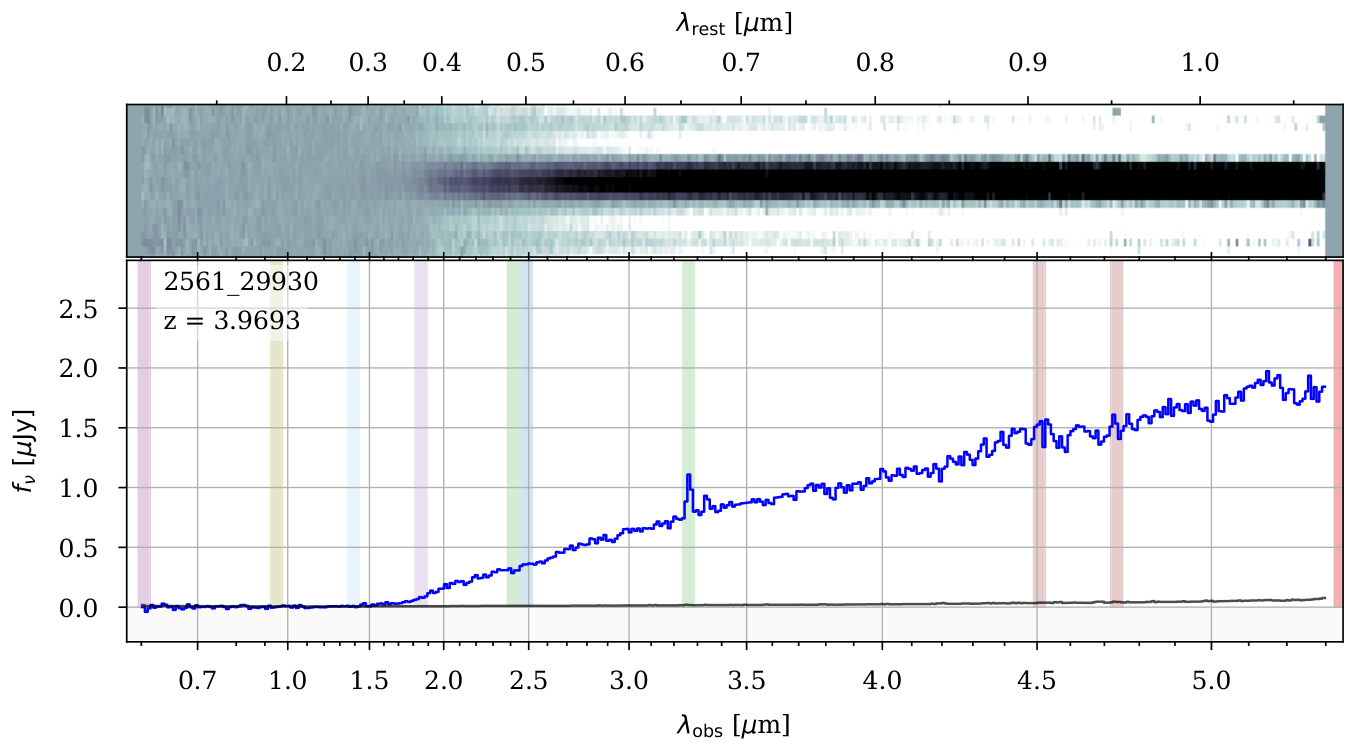
Figure 12: 2D and 1D spectrum of one of the quenched galaxies in our sample at z=3.96. The positions of the multiple well-known lines are marked with color strips. We can see the red continuum nature of the galaxy. Also, the spectrum is devoid of emission lines apart from a very weak Hα line, as is expected from a quenched galaxy.
References
-
[1] B. Alcalde Pampliega, P. G. Pérez-González, G. Barro, H. Domínguez Sánchez, M. C. Eliche-Moral, N. Cardiel, A. Hernán-Caballero, L. Rodriguez-Muñoz, P. Sánchez Blázquez, and P. Esquej (2019) Optically Faint Massive Balmer Break Galaxies at z > 3 in the CANDELS/GOODS Fields. ApJ 876 (2), pp. 135. External Links: 10.3847/1538-4357/ab14f2 Cited by: §I.
-
[2] P. Arrabal Haro, M. Dickinson, S. L. Finkelstein, J. S. Kartaltepe, C. T. Donnan, D. Burgarella, A. C. Carnall, F. Cullen, J. S. Dunlop, V. Fernández, S. Fujimoto, I. Jung, M. Krips, R. L. Larson, C. Papovich, P. G. Pérez-González, R. O. Amorín, M. B. Bagley, V. Buat, C. M. Casey, K. Chworowsky, S. H. Cohen, H. C. Ferguson, M. Giavalisco, M. Huertas-Company, T. A. Hutchison, D. D. Kocevski, A. M. Koekemoer, R. A. Lucas, D. J. McLeod, R. J. McLure, N. Pirzkal, L. Seillé, J. R. Trump, B. J. Weiner, S. M. Wilkins, and J. A. Zavala (2023) Confirmation and refutation of very luminous galaxies in the early Universe. Nature 622 (7984), pp. 707-711. External Links: 10.1038/s41586-023-06521-7 Cited by: [§IV](#S4.p4.1 "IV Low redshift (
< z 2 ) HST-dark Galaxies ‣ Optically Invisible Galaxies at Cosmic Noon and beyond with JWST/UNCOVER"). -
[3] A. J. Barger, L. L. Cowie, C.-C. Chen, F. N. Owen, W.-H. Wang, C. M. Casey, N. Lee, D. B. Sanders, and J. P. Williams (2014) Is There a Maximum Star Formation Rate in High-redshift Galaxies?. ApJ 784 (1), pp. 9. External Links: 10.1088/0004-637X/784/1/9 Cited by: §I.
-
[4] L. Barrufet, P. A. Oesch, R. Marques-Chaves, K. Arellano-Cordova, J. F. W. Baggen, A. C. Carnall, F. Cullen, J. S. Dunlop, R. Gottumukkala, Y. Fudamoto, G. D. Illingworth, D. Magee, R. J. McLure, D. J. McLeod, M. J. Michałowski, M. Stefanon, P. G. van Dokkum, and A. Weibel (2025) Quiescent or dusty? Unveiling the nature of extremely red galaxies at z > 3. MNRAS 537 (4), pp. 3453-3469. External Links: 10.1093/mnras/staf013 Cited by: §I, §I, §II, §V.1, §V.1.
-
[5] L. Barrufet, P. A. Oesch, A. Weibel, G. Brammer, R. Bezanson, R. Bouwens, Y. Fudamoto, V. Gonzalez, R. Gottumukkala, G. Illingworth, K. E. Heintz, B. Holden, I. Labbe, D. Magee, R. P. Naidu, E. Nelson, M. Stefanon, R. Smit, P. van Dokkum, J. R. Weaver, and C. C. Williams (2023) Unveiling the nature of infrared bright, optically dark galaxies with early JWST data. MNRAS 522 (1), pp. 449-456. External Links: 10.1093/mnras/stad947 Cited by: §I, §I, Figure 7, Figure 9, §V.1, §V.1, §V.1, §V.2, §V.2, §V.3, §V.3, §V.3, §V.5, §V.5, Table 2.
-
[6] R. Bezanson, I. Labbe, K. E. Whitaker, J. Leja, S. H. Price, M. Franx, G. Brammer, D. Marchesini, A. Zitrin, B. Wang, J. R. Weaver, L. J. Furtak, H. Atek, D. Coe, S. E. Cutler, P. Dayal, P. van Dokkum, R. Feldmann, N. M. Förster Schreiber, S. Fujimoto, M. Geha, K. Glazebrook, A. de Graaff, J. E. Greene, S. Juneau, S. Kassin, M. Kriek, G. Khullar, M. Maseda, L. A. Mowla, A. Muzzin, T. Nanayakkara, E. J. Nelson, P. A. Oesch, C. Pacifici, R. Pan, C. Papovich, D. J. Setton, A. E. Shapley, R. Smit, M. Stefanon, E. N. Taylor, and C. C. Williams (2024) The JWST UNCOVER Treasury Survey: Ultradeep NIRSpec and NIRCam Observations before the Epoch of Reionization. ApJ 974 (1), pp. 92. External Links: 10.3847/1538-4357/ad66cf Cited by: §I, §II.
-
[7] L. Bisigello, G. Gandolfi, A. Grazian, G. Rodighiero, L. Costantin, A. R. Cooray, A. Feltre, C. Gruppioni, N. P. Hathi, B. W. Holwerda, A. M. Koekemoer, R. A. Lucas, J. A. Newman, P. G. Pérez-González, L. Y. A. Yung, A. de la Vega, P. Arrabal Haro, M. B. Bagley, M. Dickinson, S. L. Finkelstein, J. S. Kartaltepe, C. Papovich, N. Pirzkal, and S. Wilkins (2023) Delving deep: A population of extremely dusty dwarfs observed by JWST. A&A 676, pp. A76. External Links: 10.1051/0004-6361/202346219 Cited by: [§IV](#S4.p2.1 "IV Low redshift (
        <
        z
        2


  ) HST-dark Galaxies ‣ Optically Invisible Galaxies at Cosmic Noon and beyond with JWST/UNCOVER"),
[§IV](#S4.p4.1 "IV Low redshift (
< z 2 ) HST-dark Galaxies ‣ Optically Invisible Galaxies at Cosmic Noon and beyond with JWST/UNCOVER"),§V.1.
-
[8] L. Bisigello, G. Gandolfi, A. Grazian, G. Rodighiero, G. Girardi, A. Renzini, A. Vietri, E. McGrath, B. Holwerda, A. Abdurro’uf, M. Castellano, M. Giulietti, C. Gruppioni, N. Hathi, A. M. Koekemoer, R. Lucas, F. Pacucci, P. G. Pérez-González, L. Y. A. Yung, P. Arrabal Haro, B. E. Backhaus, M. Bagley, M. Dickinson, S. Finkelstein, J. Kartaltepe, A. Kirkpatrick, C. Papovich, and N. Pirzkal (2026) HELM's deep: Highly extincted low-mass galaxies seen by JWST. A&A 706, pp. A363. External Links: 10.1051/0004-6361/202556903 Cited by: [§IV](#S4.p2.1 "IV Low redshift (
< z 2 ) HST-dark Galaxies ‣ Optically Invisible Galaxies at Cosmic Noon and beyond with JWST/UNCOVER"),§V.1.
-
[9] R. J. Bouwens, G. D. Illingworth, P. A. Oesch, M. Franx, I. Labbé, M. Trenti, P. van Dokkum, C. M. Carollo, V. González, R. Smit, and D. Magee (2012) UV-continuum Slopes at z \raisebox-2.15277pt\textasciitilde4-7 from the HUDF09+ERS+CANDELS Observations: Discovery of a Well-defined UV Color-Magnitude Relationship for z ¿= 4 Star-forming Galaxies. ApJ 754 (2), pp. 83. External Links: 10.1088/0004-637X/754/2/83 Cited by: §V.5.
-
[10] R. J. Bouwens, G. D. Illingworth, P. A. Oesch, M. Trenti, I. Labbé, M. Franx, M. Stiavelli, C. M. Carollo, P. van Dokkum, and D. Magee (2012) Lower-luminosity Galaxies Could Reionize the Universe: Very Steep Faint-end Slopes to the UV Luminosity Functions at z >= 5-8 from the HUDF09 WFC3/IR Observations. ApJ 752 (1), pp. L5. External Links: 10.1088/2041-8205/752/1/L5 Cited by: §V.5.
-
[11] R. J. Bouwens, G. Illingworth, R. S. Ellis, P. Oesch, and M. Stefanon (2022) z 2-9 Galaxies Magnified by the Hubble Frontier Field Clusters. II. Luminosity Functions and Constraints on a Faint-end Turnover. ApJ 940 (1), pp. 55. External Links: 10.3847/1538-4357/ac86d1 Cited by: Figure 11.
-
[12] M. L. Boyer, J. Anderson, M. Gennaro, M. Geha, K. B. Wingfield McQuinn, E. Tollerud, M. Correnti, M. J. Brenner Newman, R. E. Cohen, N. Kallivayalil, R. Beaton, A. A. Cole, A. Dolphin, J. S. Kalirai, K. M. Sandstrom, A. Savino, E. D. Skillman, D. R. Weisz, and B. F. Williams (2022) The JWST Resolved Stellar Populations Early Release Science Program. I. NIRCam Flux Calibration. Research Notes of the American Astronomical Society 6 (9), pp. 191. External Links: 10.3847/2515-5172/ac923a Cited by: §III.
-
[13] G. Bruzual and S. Charlot (2003) Stellar population synthesis at the resolution of 2003. MNRAS 344 (4), pp. 1000-1028. External Links: 10.1046/j.1365-8711.2003.06897.x Cited by: §III.
-
[14] T. Böker, T. L. Beck, S. M. Birkmann, G. Giardino, C. Keyes, N. Kumari, J. Muzerolle, T. Rawle, P. Zeidler, Y. Abul-Huda, C. Alves de Oliveira, S. Arribas, K. Bechtold, R. Bhatawdekar, N. Bonaventura, A. J. Bunker, A. J. Cameron, S. Carniani, S. Charlot, M. Curti, N. Espinoza, P. Ferruit, M. Franx, P. Jakobsen, D. Karakla, M. López-Caniego, N. Lützgendorf, R. Maiolino, E. Manjavacas, A. P. Marston, S. H. Moseley, P. Ogle, M. Perna, M. Peña-Guerrero, N. Pirzkal, R. Plesha, C. R. Proffitt, B. J. Rauscher, H.-W. Rix, B. Rodríguez del Pino, Z. Rustamkulov, E. Sabbi, D. K. Sing, M. Sirianni, M. te Plate, L. Úbeda, G. M. Wahlgren, E. Wislowski, R. Wu, and C. J. Willott (2023) In-orbit Performance of the Near-infrared Spectrograph NIRSpec on the James Webb Space Telescope. PASP 135 (1045), pp. 038001. External Links: 10.1088/1538-3873/acb846 Cited by: §I.
-
[15] D. Calzetti, L. Armus, R. C. Bohlin, A. L. Kinney, J. Koornneef, and T. Storchi-Bergmann (2000) The Dust Content and Opacity of Actively Star-forming Galaxies. ApJ 533 (2), pp. 682-695. External Links: 10.1086/308692 Cited by: §III.
-
[16] K. I. Caputi, O. Ilbert, C. Laigle, H. J. McCracken, O. Le Fèvre, J. Fynbo, B. Milvang-Jensen, P. Capak, M. Salvato, and Y. Taniguchi (2015) Spitzer Bright, UltraVISTA Faint Sources in COSMOS: The Contribution to the Overall Population of Massive Galaxies at z = 3-7. ApJ 810 (1), pp. 73. External Links: 10.1088/0004-637X/810/1/73 Cited by: §I, §II.
-
[17] A. C. Carnall, R. J. McLure, J. S. Dunlop, F. Cullen, D. J. McLeod, V. Wild, B. D. Johnson, S. Appleby, R. Davé, R. Amorin, M. Bolzonella, M. Castellano, A. Cimatti, O. Cucciati, A. Gargiulo, B. Garilli, F. Marchi, L. Pentericci, L. Pozzetti, C. Schreiber, M. Talia, and G. Zamorani (2019) The VANDELS survey: the star-formation histories of massive quiescent galaxies at 1.0 < z < 1.3. MNRAS 490 (1), pp. 417-439. External Links: 10.1093/mnras/stz2544 Cited by: §III.
-
[18] A. C. Carnall, R. J. McLure, J. S. Dunlop, and R. Davé (2018) Inferring the star formation histories of massive quiescent galaxies with BAGPIPES: evidence for multiple quenching mechanisms. MNRAS 480 (4), pp. 4379-4401. External Links: 10.1093/mnras/sty2169 Cited by: §III.
-
[19] A. C. Carnall, S. Walker, R. J. McLure, J. S. Dunlop, D. J. McLeod, F. Cullen, V. Wild, R. Amorin, M. Bolzonella, M. Castellano, A. Cimatti, O. Cucciati, A. Fontana, A. Gargiulo, B. Garilli, M. J. Jarvis, L. Pentericci, L. Pozzetti, G. Zamorani, A. Calabro, N. P. Hathi, and A. M. Koekemoer (2020) Timing the earliest quenching events with a robust sample of massive quiescent galaxies at 2 < z < 5. MNRAS 496 (1), pp. 695-707. External Links: 10.1093/mnras/staa1535 Cited by: §I.
-
[20] M. Castellano, A. Fontana, T. Treu, P. Santini, E. Merlin, N. Leethochawalit, M. Trenti, E. Vanzella, U. Mestric, A. Bonchi, D. Belfiori, M. Nonino, D. Paris, G. Polenta, G. Roberts-Borsani, K. Boyett, M. Bradač, A. Calabrò, K. Glazebrook, C. Grillo, S. Mascia, C. Mason, A. Mercurio, T. Morishita, T. Nanayakkara, L. Pentericci, P. Rosati, B. Vulcani, X. Wang, and L. Yang (2022) Early Results from GLASS-JWST. III. Galaxy Candidates at z 9-15. ApJ 938 (2), pp. L15. External Links: 10.3847/2041-8213/ac94d0 Cited by: footnote 6.
-
[21] M. Castellano, L. Napolitano, A. Fontana, G. Roberts-Borsani, T. Treu, E. Vanzella, J. A. Zavala, P. Arrabal Haro, A. Calabrò, M. Llerena, S. Mascia, E. Merlin, D. Paris, L. Pentericci, P. Santini, T. J. L. C. Bakx, P. Bergamini, G. Cupani, M. Dickinson, A. V. Filippenko, K. Glazebrook, C. Grillo, P. L. Kelly, M. A. Malkan, C. A. Mason, T. Morishita, T. Nanayakkara, P. Rosati, E. Sani, X. Wang, and I. Yoon (2024) JWST NIRSpec Spectroscopy of the Remarkable Bright Galaxy GHZ2/GLASS-z12 at Redshift 12.34. ApJ 972 (2), pp. 143. External Links: 10.3847/1538-4357/ad5f88 Cited by: footnote 6.
-
[22] R. K. Cochrane, D. Anglés-Alcázar, F. Cullen, and C. C. Hayward (2024) Disappearing Galaxies: The Orientation Dependence of JWST-bright, HST-dark, Star-forming Galaxy Selection. ApJ 961 (1), pp. 37. External Links: 10.3847/1538-4357/ad02f8 Cited by: §V.5.
-
[23] A. Collaboration, A. M. Price-Whelan, B. M. Sipőcz, H. M. Günther, P. L. Lim, S. M. Crawford, S. Conseil, D. L. Shupe, M. W. Craig, N. Dencheva, A. Ginsburg, J. T. Vand erPlas, L. D. Bradley, D. Pérez-Suárez, M. de Val-Borro, T. L. Aldcroft, K. L. Cruz, T. P. Robitaille, E. J. Tollerud, C. Ardelean, T. Babej, Y. P. Bach, M. Bachetti, A. V. Bakanov, S. P. Bamford, G. Barentsen, P. Barmby, A. Baumbach, K. L. Berry, F. Biscani, M. Boquien, K. A. Bostroem, L. G. Bouma, G. B. Brammer, E. M. Bray, H. Breytenbach, H. Buddelmeijer, D. J. Burke, G. Calderone, J. L. Cano Rodríguez, M. Cara, J. V. M. Cardoso, S. Cheedella, Y. Copin, L. Corrales, D. Crichton, D. D’Avella, C. Deil, É. Depagne, J. P. Dietrich, A. Donath, M. Droettboom, N. Earl, T. Erben, S. Fabbro, L. A. Ferreira, T. Finethy, R. T. Fox, L. H. Garrison, S. L. J. Gibbons, D. A. Goldstein, R. Gommers, J. P. Greco, P. Greenfield, A. M. Groener, F. Grollier, A. Hagen, P. Hirst, D. Homeier, A. J. Horton, G. Hosseinzadeh, L. Hu, J. S. Hunkeler, Ž. Ivezić, A. Jain, T. Jenness, G. Kanarek, S. Kendrew, N. S. Kern, W. E. Kerzendorf, A. Khvalko, J. King, D. Kirkby, A. M. Kulkarni, A. Kumar, A. Lee, D. Lenz, S. P. Littlefair, Z. Ma, D. M. Macleod, M. Mastropietro, C. McCully, S. Montagnac, B. M. Morris, M. Mueller, S. J. Mumford, D. Muna, N. A. Murphy, S. Nelson, G. H. Nguyen, J. P. Ninan, M. Nöthe, S. Ogaz, S. Oh, J. K. Parejko, N. Parley, S. Pascual, R. Patil, A. A. Patil, A. L. Plunkett, J. X. Prochaska, T. Rastogi, V. Reddy Janga, J. Sabater, P. Sakurikar, M. Seifert, L. E. Sherbert, H. Sherwood-Taylor, A. Y. Shih, J. Sick, M. T. Silbiger, S. Singanamalla, L. P. Singer, P. H. Sladen, K. A. Sooley, S. Sornarajah, O. Streicher, P. Teuben, S. W. Thomas, G. R. Tremblay, J. E. H. Turner, V. Terrón, M. H. van Kerkwijk, A. de la Vega, L. L. Watkins, B. A. Weaver, J. B. Whitmore, J. Woillez, V. Zabalza, and A. Contributors (2018) The Astropy Project: Building an Open-science Project and Status of the v2.0 Core Package. AJ 156 (3), pp. 123. External Links: 10.3847/1538-3881/aabc4f Cited by: Optically Invisible Galaxies at Cosmic Noon and beyond with JWST/UNCOVER.
-
[24] A. Collaboration, A. M. Price-Whelan, P. L. Lim, N. Earl, N. Starkman, L. Bradley, D. L. Shupe, A. A. Patil, L. Corrales, C. E. Brasseur, M. Nöthe, A. Donath, E. Tollerud, B. M. Morris, A. Ginsburg, E. Vaher, B. A. Weaver, J. Tocknell, W. Jamieson, M. H. van Kerkwijk, T. P. Robitaille, B. Merry, M. Bachetti, H. M. Günther, T. L. Aldcroft, J. A. Alvarado-Montes, A. M. Archibald, A. Bódi, S. Bapat, G. Barentsen, J. Bazán, M. Biswas, M. Boquien, D. J. Burke, D. Cara, M. Cara, K. E. Conroy, S. Conseil, M. W. Craig, R. M. Cross, K. L. Cruz, F. D’Eugenio, N. Dencheva, H. A. R. Devillepoix, J. P. Dietrich, A. D. Eigenbrot, T. Erben, L. Ferreira, D. Foreman-Mackey, R. Fox, N. Freij, S. Garg, R. Geda, L. Glattly, Y. Gondhalekar, K. D. Gordon, D. Grant, P. Greenfield, A. M. Groener, S. Guest, S. Gurovich, R. Handberg, A. Hart, Z. Hatfield-Dodds, D. Homeier, G. Hosseinzadeh, T. Jenness, C. K. Jones, P. Joseph, J. B. Kalmbach, E. Karamehmetoglu, M. Kałuszyński, M. S. P. Kelley, N. Kern, W. E. Kerzendorf, E. W. Koch, S. Kulumani, A. Lee, C. Ly, Z. Ma, C. MacBride, J. M. Maljaars, D. Muna, N. A. Murphy, H. Norman, R. O’Steen, K. A. Oman, C. Pacifici, S. Pascual, J. Pascual-Granado, R. R. Patil, G. I. Perren, T. E. Pickering, T. Rastogi, B. R. Roulston, D. F. Ryan, E. S. Rykoff, J. Sabater, P. Sakurikar, J. Salgado, A. Sanghi, N. Saunders, V. Savchenko, L. Schwardt, M. Seifert-Eckert, A. Y. Shih, A. S. Jain, G. Shukla, J. Sick, C. Simpson, S. Singanamalla, L. P. Singer, J. Singhal, M. Sinha, B. M. Sipőcz, L. R. Spitler, D. Stansby, O. Streicher, J. Šumak, J. D. Swinbank, D. S. Taranu, N. Tewary, G. R. Tremblay, M. de Val-Borro, S. J. Van Kooten, Z. Vasović, S. Verma, J. V. de Miranda Cardoso, P. K. G. Williams, T. J. Wilson, B. Winkel, W. M. Wood-Vasey, R. Xue, P. Yoachim, C. Zhang, A. Zonca, and A. P. Contributors (2022) The Astropy Project: Sustaining and Growing a Community-oriented Open-source Project and the Latest Major Release (v5.0) of the Core Package. ApJ 935 (2), pp. 167. External Links: 10.3847/1538-4357/ac7c74 Cited by: Optically Invisible Galaxies at Cosmic Noon and beyond with JWST/UNCOVER.
-
[25] A. Collaboration, T. P. Robitaille, E. J. Tollerud, P. Greenfield, M. Droettboom, E. Bray, T. Aldcroft, M. Davis, A. Ginsburg, A. M. Price-Whelan, W. E. Kerzendorf, A. Conley, N. Crighton, K. Barbary, D. Muna, H. Ferguson, F. Grollier, M. M. Parikh, P. H. Nair, H. M. Unther, C. Deil, J. Woillez, S. Conseil, R. Kramer, J. E. H. Turner, L. Singer, R. Fox, B. A. Weaver, V. Zabalza, Z. I. Edwards, K. Azalee Bostroem, D. J. Burke, A. R. Casey, S. M. Crawford, N. Dencheva, J. Ely, T. Jenness, K. Labrie, P. L. Lim, F. Pierfederici, A. Pontzen, A. Ptak, B. Refsdal, M. Servillat, and O. Streicher (2013) Astropy: A community Python package for astronomy. A&A 558, pp. A33. External Links: 10.1051/0004-6361/201322068 Cited by: Optically Invisible Galaxies at Cosmic Noon and beyond with JWST/UNCOVER.
-
[26] P. Collaboration, N. Aghanim, Y. Akrami, M. Ashdown, J. Aumont, C. Baccigalupi, M. Ballardini, A. J. Banday, R. B. Barreiro, N. Bartolo, S. Basak, R. Battye, K. Benabed, J.-P. Bernard, M. Bersanelli, P. Bielewicz, J. J. Bock, J. R. Bond, J. Borrill, F. R. Bouchet, F. Boulanger, M. Bucher, C. Burigana, R. C. Butler, E. Calabrese, J.-F. Cardoso, J. Carron, A. Challinor, H. C. Chiang, J. Chluba, L. P. L. Colombo, C. Combet, D. Contreras, B. P. Crill, F. Cuttaia, P. de Bernardis, G. de Zotti, J. Delabrouille, J.-M. Delouis, E. Di Valentino, J. M. Diego, O. Doré, M. Douspis, A. Ducout, X. Dupac, S. Dusini, G. Efstathiou, F. Elsner, T. A. Enßlin, H. K. Eriksen, Y. Fantaye, M. Farhang, J. Fergusson, R. Fernandez-Cobos, F. Finelli, F. Forastieri, M. Frailis, A. A. Fraisse, E. Franceschi, A. Frolov, S. Galeotta, S. Galli, K. Ganga, R. T. Génova-Santos, M. Gerbino, T. Ghosh, J. González-Nuevo, K. M. Górski, S. Gratton, A. Gruppuso, J. E. Gudmundsson, J. Hamann, W. Handley, F. K. Hansen, D. Herranz, S. R. Hildebrandt, E. Hivon, Z. Huang, A. H. Jaffe, W. C. Jones, A. Karakci, E. Keihänen, R. Keskitalo, K. Kiiveri, J. Kim, T. S. Kisner, L. Knox, N. Krachmalnicoff, M. Kunz, H. Kurki-Suonio, G. Lagache, J.-M. Lamarre, A. Lasenby, M. Lattanzi, C. R. Lawrence, M. Le Jeune, P. Lemos, J. Lesgourgues, F. Levrier, A. Lewis, M. Liguori, P. B. Lilje, M. Lilley, V. Lindholm, M. López-Caniego, P. M. Lubin, Y.-Z. Ma, J. F. Macías-Pérez, G. Maggio, D. Maino, N. Mandolesi, A. Mangilli, A. Marcos-Caballero, M. Maris, P. G. Martin, M. Martinelli, E. Martínez-González, S. Matarrese, N. Mauri, J. D. McEwen, P. R. Meinhold, A. Melchiorri, A. Mennella, M. Migliaccio, M. Millea, S. Mitra, M.-A. Miville-Deschênes, D. Molinari, L. Montier, G. Morgante, A. Moss, P. Natoli, H. U. Nørgaard-Nielsen, L. Pagano, D. Paoletti, B. Partridge, G. Patanchon, H. V. Peiris, F. Perrotta, V. Pettorino, F. Piacentini, L. Polastri, G. Polenta, J.-L. Puget, J. P. Rachen, M. Reinecke, M. Remazeilles, A. Renzi, G. Rocha, C. Rosset, G. Roudier, J. A. Rubiño-Martín, B. Ruiz-Granados, L. Salvati, M. Sandri, M. Savelainen, D. Scott, E. P. S. Shellard, C. Sirignano, G. Sirri, L. D. Spencer, R. Sunyaev, A.-S. Suur-Uski, J. A. Tauber, D. Tavagnacco, M. Tenti, L. Toffolatti, M. Tomasi, T. Trombetti, L. Valenziano, J. Valiviita, B. Van Tent, L. Vibert, P. Vielva, F. Villa, N. Vittorio, B. D. Wandelt, I. K. Wehus, M. White, S. D. M. White, A. Zacchei, and A. Zonca (2020) Planck 2018 results. VI. Cosmological parameters. A&A 641, pp. A6. External Links: 10.1051/0004-6361/201833910 Cited by: §I.
-
[27] E. da Cunha, F. Walter, I. R. Smail, A. M. Swinbank, J. M. Simpson, R. Decarli, J. A. Hodge, A. Weiss, P. P. van der Werf, F. Bertoldi, S. C. Chapman, P. Cox, A. L. R. Danielson, H. Dannerbauer, T. R. Greve, R. J. Ivison, A. Karim, and A. Thomson (2015) An ALMA Survey of Sub-millimeter Galaxies in the Extended Chandra Deep Field South: Physical Properties Derived from Ultraviolet-to-radio Modeling. ApJ 806 (1), pp. 110. External Links: 10.1088/0004-637X/806/1/110 Cited by: Figure 7, Figure 9, §V.2, §V.2, §V.5, §V.5, Table 2.
-
[28] J. Falcón-Barroso, P. Sánchez-Blázquez, A. Vazdekis, E. Ricciardelli, N. Cardiel, A. J. Cenarro, J. Gorgas, and R. F. Peletier (2011) An updated MILES stellar library and stellar population models. A&A 532, pp. A95. External Links: 10.1051/0004-6361/201116842 Cited by: §III.
-
[29] G. J. Ferland, M. Chatzikos, F. Guzmán, M. L. Lykins, P. A. M. van Hoof, R. J. R. Williams, N. P. Abel, N. R. Badnell, F. P. Keenan, R. L. Porter, and P. C. Stancil (2017) The 2017 Release Cloudy. Rev. Mexicana Astron. Astrofis. 53, pp. 385-438. External Links: 10.48550/arXiv.1705.10877 Cited by: §III.
-
[30] F. Feroz, M. P. Hobson, and M. Bridges (2009) MULTINEST: an efficient and robust Bayesian inference tool for cosmology and particle physics. MNRAS 398 (4), pp. 1601-1614. External Links: 10.1111/j.1365-2966.2009.14548.x Cited by: §III.
-
[31] F. Feroz and M. P. Hobson (2008) Multimodal nested sampling: an efficient and robust alternative to Markov Chain Monte Carlo methods for astronomical data analyses. MNRAS 384 (2), pp. 449-463. External Links: 10.1111/j.1365-2966.2007.12353.x Cited by: §III.
-
[32] F. Feroz, M. P. Hobson, E. Cameron, and A. N. Pettitt (2019) Importance Nested Sampling and the MultiNest Algorithm. The Open Journal of Astrophysics 2 (1), pp. 10. External Links: 10.21105/astro.1306.2144 Cited by: §III.
-
[33] S. L. Finkelstein, M. B. Bagley, P. Arrabal Haro, M. Dickinson, H. C. Ferguson, J. S. Kartaltepe, D. D. Kocevski, A. M. Koekemoer, J. M. Lotz, C. Papovich, P. G. Pérez-González, N. Pirzkal, R. S. Somerville, J. R. Trump, G. Yang, L. Y. A. Yung, A. Fontana, A. Grazian, N. A. Grogin, L. J. Kewley, A. Kirkpatrick, R. L. Larson, L. Pentericci, S. Ravindranath, S. M. Wilkins, O. Almaini, R. O. Amorín, G. Barro, R. Bhatawdekar, L. Bisigello, M. Brooks, V. Buat, F. Buitrago, D. Burgarella, A. Calabrò, M. Castellano, Y. Cheng, N. J. Cleri, J. W. Cole, M. C. Cooper, O. R. Cooper, L. Costantin, I. G. Cox, D. Croton, E. Daddi, K. Davis, A. Dekel, D. Elbaz, V. Fernández, S. Fujimoto, G. Gandolfi, J. P. Gardner, E. Gawiser, M. Giavalisco, C. Gómez-Guijarro, Y. Guo, A. R. Gupta, N. P. Hathi, S. Harish, A. Henry, M. Hirschmann, W. Hu, T. A. Hutchison, K. G. Iyer, A. E. Jaskot, S. W. Jha, I. Jung, S. A. Kassin, V. Kokorev, P. Kurczynski, G. C. K. Leung, M. Llerena, A. S. Long, R. A. Lucas, S. Lu, E. J. McGrath, D. H. McIntosh, E. Merlin, B. Mobasher, A. M. Morales, L. Napolitano, F. Pacucci, V. Pandya, M. Rafelski, G. Rodighiero, C. Rose, P. Santini, L. Seillé, R. C. Simons, L. Shen, A. N. Straughn, S. Tacchella, A. J. Taylor, B. N. Vanderhoof, J. Vega-Ferrero, B. J. Weiner, C. N. A. Willmer, P. Zhu, E. F. Bell, S. Wuyts, B. W. Holwerda, X. Wang, W. Wang, J. A. Zavala, and C. Collaboration (2025) The Cosmic Evolution Early Release Science Survey (CEERS). ApJ 983 (1), pp. L4. External Links: 10.3847/2041-8213/adbbd3 Cited by: §I, §II.
-
[34] M. Franco, D. Elbaz, M. Béthermin, B. Magnelli, C. Schreiber, L. Ciesla, M. Dickinson, N. Nagar, J. Silverman, E. Daddi, D. M. Alexander, T. Wang, M. Pannella, E. Le Floc’h, A. Pope, M. Giavalisco, A. J. Maury, F. Bournaud, R. Chary, R. Demarco, H. Ferguson, S. L. Finkelstein, H. Inami, D. Iono, S. Juneau, G. Lagache, R. Leiton, L. Lin, G. Magdis, H. Messias, K. Motohara, J. Mullaney, K. Okumura, C. Papovich, J. Pforr, W. Rujopakarn, M. Sargent, X. Shu, and L. Zhou (2018) GOODS-ALMA: 1.1 mm galaxy survey. I. Source catalog and optically dark galaxies. A&A 620, pp. A152. External Links: 10.1051/0004-6361/201832928 Cited by: §I.
-
[35] Y. Fudamoto, P. A. Oesch, S. Schouws, M. Stefanon, R. Smit, R. J. Bouwens, R. A. A. Bowler, R. Endsley, V. Gonzalez, H. Inami, I. Labbe, D. Stark, M. Aravena, L. Barrufet, E. da Cunha, P. Dayal, A. Ferrara, L. Graziani, J. Hodge, A. Hutter, Y. Li, I. De Looze, T. Nanayakkara, A. Pallottini, D. Riechers, R. Schneider, G. Ucci, P. van der Werf, and C. White (2021) Normal, dust-obscured galaxies in the epoch of reionization. Nature 597 (7877), pp. 489-492. External Links: 10.1038/s41586-021-03846-z Cited by: §I.
-
[36] L. J. Furtak, A. Zitrin, A. Plat, S. Fujimoto, B. Wang, E. J. Nelson, I. Labbé, R. Bezanson, G. B. Brammer, P. van Dokkum, R. Endsley, K. Glazebrook, J. E. Greene, J. Leja, S. H. Price, R. Smit, D. P. Stark, J. R. Weaver, K. E. Whitaker, H. Atek, J. Chevallard, E. Curtis-Lake, P. Dayal, A. Feltre, M. Franx, Y. Fudamoto, D. Marchesini, L. A. Mowla, R. Pan, K. A. Suess, A. Vidal-García, and C. C. Williams (2023) JWST UNCOVER: Extremely Red and Compact Object at z ₚhot ≃ 7.6 Triply Imaged by A2744. ApJ 952 (2), pp. 142. External Links: 10.3847/1538-4357/acdc9d Cited by: §III.
-
[37] N. Gehrels (1986) Confidence Limits for Small Numbers of Events in Astrophysical Data. ApJ 303, pp. 336. External Links: 10.1086/164079 Cited by: §V.5.
-
[38] F. Gentile, M. Talia, A. Enia, F. Pozzi, A. Traina, G. Zamorani, I. T. Andika, M. Behiri, L. Barrufet, C. M. Casey, A. Cimatti, N. E. Drakos, A. L. Faisst, M. Franco, S. Gillman, M. Giulietti, R. Gottumukkala, C. C. Hayward, O. Ilbert, S. Jin, A. Lapi, J. McKinney, M. Shuntov, M. Vaccari, C. Vignali, H. B. Akins, N. Allen, S. Harish, H. J. McCracken, J. S. Kartaltepe, A. M. Koekemoer, D. Liu, L. Paquereau, J. Rhodes, M. R. Rich, B. E. Robertson, and S. Toft (2025) Going deeper into the dark with COSMOS-Web: JWST unveils the total contribution of radio-selected NIR-faint galaxies to the cosmic star formation rate density. A&A 697, pp. A46. External Links: 10.1051/0004-6361/202452461 Cited by: §I, §V.5.
-
[39] A. Glasse, G. H. Rieke, E. Bauwens, M. García-Marín, M. E. Ressler, S. Rost, T. V. Tikkanen, B. Vandenbussche, and G. S. Wright (2015) The Mid-Infrared Instrument for the James Webb Space Telescope, IX: Predicted Sensitivity. PASP 127 (953), pp. 686. External Links: 10.1086/682259 Cited by: §I.
-
[40] T. P. Greene, D. M. Kelly, J. Stansberry, J. Leisenring, E. Egami, E. Schlawin, L. Chu, K. W. Hodapp, and M. Rieke (2017) λ = 2.4 to 5 μm spectroscopy with the James Webb Space Telescope NIRCam instrument. Journal of Astronomical Telescopes, Instruments, and Systems 3, pp. 035001. External Links: 10.1117/1.JATIS.3.3.035001 Cited by: §I.
-
[41] C. R. Harris, K. J. Millman, S. J. van der Walt, R. Gommers, P. Virtanen, D. Cournapeau, E. Wieser, J. Taylor, S. Berg, N. J. Smith, R. Kern, M. Picus, S. Hoyer, M. H. van Kerkwijk, M. Brett, A. Haldane, J. F. del Río, M. Wiebe, P. Peterson, P. Gérard-Marchant, K. Sheppard, T. Reddy, W. Weckesser, H. Abbasi, C. Gohlke, and T. E. Oliphant (2020) Array programming with NumPy. Nature 585 (7825), pp. 357-362. External Links: 10.1038/s41586-020-2649-2 Cited by: Optically Invisible Galaxies at Cosmic Noon and beyond with JWST/UNCOVER.
-
[42] J.-S. Huang, X. Z. Zheng, D. Rigopoulou, G. Magdis, G. G. Fazio, and T. Wang (2011) Four IRAC Sources with an Extremely Red H - [3.6] Color: Passive or Dusty Galaxies at z > 4.5?. ApJ 742 (1), pp. L13. External Links: 10.1088/2041-8205/742/1/L13 Cited by: §I.
-
[43] J. D. Hunter (2007) Matplotlib: A 2D Graphics Environment. Computing in Science and Engineering 9 (3), pp. 90-95. External Links: 10.1109/MCSE.2007.55 Cited by: Optically Invisible Galaxies at Cosmic Noon and beyond with JWST/UNCOVER.
-
[44] P. Jakobsen, P. Ferruit, C. Alves de Oliveira, S. Arribas, G. Bagnasco, R. Barho, T. L. Beck, S. Birkmann, T. Böker, A. J. Bunker, S. Charlot, P. de Jong, G. de Marchi, R. Ehrenwinkler, M. Falcolini, R. Fels, M. Franx, D. Franz, M. Funke, G. Giardino, X. Gnata, W. Holota, K. Honnen, P. L. Jensen, M. Jentsch, T. Johnson, D. Jollet, H. Karl, G. Kling, J. Köhler, M.-G. Kolm, N. Kumari, M. E. Lander, R. Lemke, M. López-Caniego, N. Lützgendorf, R. Maiolino, E. Manjavacas, A. Marston, M. Maschmann, R. Maurer, B. Messerschmidt, S. H. Moseley, P. Mosner, D. B. Mott, J. Muzerolle, N. Pirzkal, J.-F. Pittet, A. Plitzke, W. Posselt, B. Rapp, B. J. Rauscher, T. Rawle, H.-W. Rix, A. Rödel, P. Rumler, E. Sabbi, J.-C. Salvignol, T. Schmid, M. Sirianni, C. Smith, P. Strada, M. te Plate, J. Valenti, T. Wettemann, T. Wiehe, M. Wiesmayer, C. J. Willott, R. Wright, P. Zeidler, and C. Zincke (2022) The Near-Infrared Spectrograph (NIRSpec) on the James Webb Space Telescope. I. Overview of the instrument and its capabilities. A&A 661, pp. A80. External Links: 10.1051/0004-6361/202142663 Cited by: §I.
-
[45] W. A. Joye and E. Mandel (2003) New Features of SAOImage DS9. In Astronomical Data Analysis Software and Systems XII, (H. E. Payne, R. I. Jedrzejewski, and R. N. Hook Eds.), pp. 489. Cited by: Optically Invisible Galaxies at Cosmic Noon and beyond with JWST/UNCOVER.
-
[46] W. A. Joye and E. Mandel (2005) The Development of SAOImage DS9: Lessons Learned from a Small but Successful Software Project. In Astronomical Data Analysis Software and Systems XIV, (P. Shopbell, M. Britton, and R. Ebert Eds.), pp. 110. Cited by: Optically Invisible Galaxies at Cosmic Noon and beyond with JWST/UNCOVER.
-
[47] W. A. Joye (2006) New Features of SAOImage DS9. In Astronomical Data Analysis Software and Systems XV, (C. Gabriel, C. Arviset, D. Ponz, and S. Enrique Eds.), pp. 574. Cited by: Optically Invisible Galaxies at Cosmic Noon and beyond with JWST/UNCOVER.
-
[48] W. Joye (2011) SAOImage DS9 Frequently Asked Questions. In Astronomical Data Analysis Software and Systems XX, (I. N. Evans, A. Accomazzi, D. J. Mink, and A. H. Rots Eds.), pp. 633. Cited by: Optically Invisible Galaxies at Cosmic Noon and beyond with JWST/UNCOVER.
-
[49] P. Kroupa and C. M. Boily (2002) On the mass function of star clusters. MNRAS 336 (4), pp. 1188-1194. External Links: 10.1046/j.1365-8711.2002.05848.x Cited by: §III.
-
[50] H. Leung, A. C. Carnall, E. Taylor, S. D. Stevenson, A. G. Beverage, F. Cullen, J. S. Dunlop, D. J. McLeod, R. J. McLure, R. Begley, O. Almaini, S. Antonogiannaki, K. Z. Arellano-Córdova, L. Barrufet, C. Bondestam, C. T. Donnan, I. J. B. Holst, F. F. Liu, K. Rowlands, R. L. Sanders, D. Scholte, M. Skarbinski, T. M. Stanton, and V. Wild (2026) The JWST EXCELS survey: The ages and abundances of 3<z<5 massive quiescent galaxies show that downsizing was already in place by z≃4. arXiv e-prints, pp. arXiv:2602.05934. External Links: 10.48550/arXiv.2602.05934 Cited by: §I.
-
[51] P. Madau and M. Dickinson (2014) Cosmic Star-Formation History. ARA&A 52, pp. 415-486. External Links: 10.1146/annurev-astro-081811-125615 Cited by: §V.5.
-
[52] D. P. Marrone, J. S. Spilker, C. C. Hayward, J. D. Vieira, M. Aravena, M. L. N. Ashby, M. B. Bayliss, M. Béthermin, M. Brodwin, M. S. Bothwell, J. E. Carlstrom, S. C. Chapman, C. Chen, T. M. Crawford, D. J. M. Cunningham, C. De Breuck, C. D. Fassnacht, A. H. Gonzalez, T. R. Greve, Y. D. Hezaveh, K. Lacaille, K. C. Litke, S. Lower, J. Ma, M. Malkan, T. B. Miller, W. R. Morningstar, E. J. Murphy, D. Narayanan, K. A. Phadke, K. M. Rotermund, J. Sreevani, B. Stalder, A. A. Stark, M. L. Strandet, M. Tang, and A. Weiß (2018) Galaxy growth in a massive halo in the first billion years of cosmic history. Nature 553 (7686), pp. 51-54. External Links: 10.1038/nature24629 Cited by: §I.
-
[53] W. McKinney (2010) Data Structures for Statistical Computing in Python . In Proceedings of the 9th Python in Science Conference , (S. v. d. Walt and J. Millman Eds.), pp. 56 - 61 . External Links: 10.25080/Majora-92bf1922-00a Cited by: Optically Invisible Galaxies at Cosmic Noon and beyond with JWST/UNCOVER.
-
[54] M. J. Michałowski, J. S. Dunlop, M. P. Koprowski, M. Cirasuolo, J. E. Geach, R. A. A. Bowler, A. Mortlock, K. I. Caputi, I. Aretxaga, V. Arumugam, C. Chen, R. J. McLure, M. Birkinshaw, N. Bourne, D. Farrah, E. Ibar, P. van der Werf, and M. Zemcov (2017) The SCUBA-2 Cosmology Legacy Survey: the nature of bright submm galaxies from 2 deg² of 850-μm imaging. MNRAS 469 (1), pp. 492-515. External Links: 10.1093/mnras/stx861 Cited by: §I, §V.5.
-
[55] R. P. Naidu, J. Matthee, I. Kramarenko, A. Weibel, G. Brammer, P. A. Oesch, P. Lechner, L. J. Furtak, C. Di Cesare, A. Torralba, G. Kotiwale, R. Bezanson, R. J. Bouwens, V. Chandra, A. Claeyssens, A. L. Danhaive, A. Frebel, A. de Graaff, J. E. Greene, K. E. Heintz, A. P. Ji, D. Kashino, H. Katz, I. Labbe, J. Leja, Y. Li, M. V. Maseda, J. Richard, I. Shivaei, R. A. Simcoe, D. Sobral, K. A. Suess, S. Tacchella, and C. C. Williams (2024) All the Little Things in Abell 2744: >\1000 Gravitationally Lensed Dwarf Galaxies at z=0-9 from JWST NIRCam Grism Spectroscopy. arXiv e-prints, pp. arXiv:2410.01874. External Links: 10.48550/arXiv.2410.01874 Cited by: §II.
-
[56] R. P. Naidu, P. A. Oesch, P. van Dokkum, E. J. Nelson, K. A. Suess, G. Brammer, K. E. Whitaker, G. Illingworth, R. Bouwens, S. Tacchella, J. Matthee, N. Allen, R. Bezanson, C. Conroy, I. Labbe, J. Leja, E. Leonova, D. Magee, S. H. Price, D. J. Setton, V. Strait, M. Stefanon, S. Toft, J. R. Weaver, and A. Weibel (2022) Two Remarkably Luminous Galaxy Candidates at z ≈ 10-12 Revealed by JWST. ApJ 940 (1), pp. L14. External Links: 10.3847/2041-8213/ac9b22 Cited by: footnote 6.
-
[57] J. B. Oke and J. E. Gunn (1983) Secondary standard stars for absolute spectrophotometry.. ApJ 266, pp. 713-717. External Links: 10.1086/160817 Cited by: §I.
-
[58] S. H. Price, R. Bezanson, I. Labbe, L. J. Furtak, A. de Graaff, J. E. Greene, V. Kokorev, D. J. Setton, K. A. Suess, G. Brammer, S. E. Cutler, J. Leja, R. Pan, B. Wang, J. R. Weaver, K. E. Whitaker, H. Atek, A. J. Burgasser, I. Chemerynska, P. Dayal, R. Feldmann, N. M. Förster Schreiber, Y. Fudamoto, S. Fujimoto, K. Glazebrook, A. D. Goulding, G. Khullar, M. Kriek, D. Marchesini, M. V. Maseda, T. B. Miller, A. Muzzin, T. Nanayakkara, E. Nelson, P. A. Oesch, H. Shipley, R. Smit, E. N. Taylor, P. v. Dokkum, C. C. Williams, and A. Zitrin (2025) The UNCOVER Survey: First Release of Ultradeep JWST/NIRSpec PRISM Spectra for \sim\700 Galaxies from z ∼ 0.3─13 in A2744. ApJ 982 (1), pp. 51. External Links: 10.3847/1538-4357/adaec1 Cited by: §III.
-
[59] P. G. Pérez-González, G. Barro, M. Annunziatella, L. Costantin, Á. García-Argumánez, E. J. McGrath, R. M. Mérida, J. A. Zavala, P. Arrabal Haro, M. B. Bagley, B. E. Backhaus, P. Behroozi, E. F. Bell, L. Bisigello, V. Buat, A. Calabrò, C. M. Casey, N. J. Cleri, R. T. Coogan, M. C. Cooper, A. R. Cooray, A. Dekel, M. Dickinson, D. Elbaz, H. C. Ferguson, S. L. Finkelstein, A. Fontana, M. Franco, J. P. Gardner, M. Giavalisco, C. Gómez-Guijarro, A. Grazian, N. A. Grogin, Y. Guo, M. Huertas-Company, S. Jogee, J. S. Kartaltepe, L. J. Kewley, A. Kirkpatrick, D. D. Kocevski, A. M. Koekemoer, A. S. Long, J. M. Lotz, R. A. Lucas, C. Papovich, N. Pirzkal, S. Ravindranath, R. S. Somerville, S. Tacchella, J. R. Trump, W. Wang, S. M. Wilkins, S. Wuyts, G. Yang, and L. Y. A. Yung (2023) CEERS Key Paper. IV. A Triality in the Nature of HST-dark Galaxies. ApJ 946 (1), pp. L16. External Links: 10.3847/2041-8213/acb3a5 Cited by: §I, §I, §II, §V.1, §V.1, §V.1, §V.2, §V.3.
-
[60] P. G. Pérez-González, P. Rinaldi, K. I. Caputi, J. Álvarez-Márquez, M. Annunziatella, D. Langeroodi, T. Moutard, L. Boogaard, E. Iani, J. Melinder, L. Costantin, G. Östlin, L. Colina, T. R. Greve, G. Wright, A. Alonso-Herrero, A. Bik, S. E. I. Bosman, A. Crespo Gómez, D. Dicken, A. Eckart, M. García-Marín, S. Gillman, M. Güdel, T. Henning, J. Hjorth, I. Jermann, Á. Labiano, R. A. Meyer, F. Peiβker, J. P. Pye, T. P. Ray, T. Tikkanen, F. Walter, and P. P. van der Werf (2024) A NIRCam-dark Galaxy Detected with the MIRI/F1000W Filter in the MIDIS/JADES Hubble Ultra Deep Field. ApJ 969 (1), pp. L10. External Links: 10.3847/2041-8213/ad517b Cited by: §I.
-
[61] D. A. Riechers, C. M. Bradford, D. L. Clements, C. D. Dowell, I. Pérez-Fournon, R. J. Ivison, C. Bridge, A. Conley, H. Fu, J. D. Vieira, J. Wardlow, J. Calanog, A. Cooray, P. Hurley, R. Neri, J. Kamenetzky, J. E. Aguirre, B. Altieri, V. Arumugam, D. J. Benford, M. Béthermin, J. Bock, D. Burgarella, A. Cabrera-Lavers, S. C. Chapman, P. Cox, J. S. Dunlop, L. Earle, D. Farrah, P. Ferrero, A. Franceschini, R. Gavazzi, J. Glenn, E. A. G. Solares, M. A. Gurwell, M. Halpern, E. Hatziminaoglou, A. Hyde, E. Ibar, A. Kovács, M. Krips, R. E. Lupu, P. R. Maloney, P. Martinez-Navajas, H. Matsuhara, E. J. Murphy, B. J. Naylor, H. T. Nguyen, S. J. Oliver, A. Omont, M. J. Page, G. Petitpas, N. Rangwala, I. G. Roseboom, D. Scott, A. J. Smith, J. G. Staguhn, A. Streblyanska, A. P. Thomson, I. Valtchanov, M. Viero, L. Wang, M. Zemcov, and J. Zmuidzinas (2013) A dust-obscured massive maximum-starburst galaxy at a redshift of 6.34. Nature 496 (7445), pp. 329-333. External Links: 10.1038/nature12050 Cited by: §I.
-
[62] M. J. Rieke, S. A. Baum, C. A. Beichman, D. Crampton, R. Doyon, D. Eisenstein, T. P. Greene, K. Hodapp, S. D. Horner, D. Johnstone, L. Lesyna, S. Lilly, M. Meyer, P. Martin, J. D. W. McCarthy, G. H. Rieke, T. L. Roellig, J. Stauffer, J. T. Trauger, and E. T. Young (2003) NGST NIRCam Scientific Program and Design Concept. In IR Space Telescopes and Instruments, (J. C. Mather Ed.), pp. 478-485. External Links: 10.1117/12.489103 Cited by: §I.
-
[63] M. J. Rieke, D. Kelly, and S. Horner (2005) Overview of James Webb Space Telescope and NIRCam's Role. In Cryogenic Optical Systems and Instruments XI, (J. B. Heaney and L. G. Burriesci Eds.), pp. 1-8. External Links: 10.1117/12.615554 Cited by: §I.
-
[64] M. J. Rieke, D. M. Kelly, K. Misselt, J. Stansberry, M. Boyer, T. Beatty, E. Egami, M. Florian, T. P. Greene, K. Hainline, J. Leisenring, T. Roellig, E. Schlawin, F. Sun, L. Tinnin, C. C. Williams, C. N. A. Willmer, D. Wilson, C. R. Clark, S. Rohrbach, B. Brooks, A. Canipe, M. Correnti, A. DiFelice, M. Gennaro, J. H. Girard, G. Hartig, B. Hilbert, A. M. Koekemoer, N. K. Nikolov, N. Pirzkal, A. Rest, M. Robberto, B. Sunnquist, R. Telfer, C. R. Wu, M. Ferry, D. Lewis, S. Baum, C. Beichman, R. Doyon, A. Dressler, D. J. Eisenstein, L. Ferrarese, K. Hodapp, S. Horner, D. T. Jaffe, D. Johnstone, J. Krist, P. Martin, D. W. McCarthy, M. Meyer, G. H. Rieke, J. Trauger, and E. T. Young (2023) Performance of NIRCam on JWST in Flight. PASP 135 (1044), pp. 028001. External Links: 10.1088/1538-3873/acac53 Cited by: §I.
-
[65] V. Rodriguez-Gomez, G. F. Snyder, J. M. Lotz, D. Nelson, A. Pillepich, V. Springel, S. Genel, R. Weinberger, S. Tacchella, R. Pakmor, P. Torrey, F. Marinacci, M. Vogelsberger, L. Hernquist, and D. A. Thilker (2019) The optical morphologies of galaxies in the IllustrisTNG simulation: a comparison to Pan-STARRS observations. MNRAS 483 (3), pp. 4140-4159. External Links: 10.1093/mnras/sty3345 Cited by: §V.4.
-
[66] G. Santucci, S. Brough, N. Scott, M. Montes, M. S. Owers, J. van Sande, J. Bland-Hawthorn, J. J. Bryant, S. M. Croom, I. Ferreras, J. S. Lawrence, Á. R. López-Sánchez, and S. N. Richards (2020) The SAMI Galaxy Survey: Stellar Population Gradients of Central Galaxies. ApJ 896 (1), pp. 75. External Links: 10.3847/1538-4357/ab92a9 Cited by: §I.
-
[67] C. Schreiber, M. Pannella, D. Elbaz, M. Béthermin, H. Inami, M. Dickinson, B. Magnelli, T. Wang, H. Aussel, E. Daddi, S. Juneau, X. Shu, M. T. Sargent, V. Buat, S. M. Faber, H. C. Ferguson, M. Giavalisco, A. M. Koekemoer, G. Magdis, G. E. Morrison, C. Papovich, P. Santini, and D. Scott (2015) The Herschel view of the dominant mode of galaxy growth from z = 4 to the present day. A&A 575, pp. A74. External Links: 10.1051/0004-6361/201425017 Cited by: §V.2.
-
[68] SAOImage DS9: A utility for displaying astronomical images in the X11 window environment Cited by: Optically Invisible Galaxies at Cosmic Noon and beyond with JWST/UNCOVER.
-
[69] L. R. Spitler, C. M. S. Straatman, I. Labbé, K. Glazebrook, K. H. Tran, G. G. Kacprzak, R. F. Quadri, C. Papovich, S. E. Persson, P. van Dokkum, R. Allen, L. Kawinwanichakij, D. D. Kelson, P. J. McCarthy, N. Mehrtens, A. J. Monson, T. Nanayakkara, G. Rees, V. Tilvi, and A. R. Tomczak (2014) Exploring the z = 3-4 Massive Galaxy Population with ZFOURGE: The Prevalence of Dusty and Quiescent Galaxies. ApJ 787 (2), pp. L36. External Links: 10.1088/2041-8205/787/2/L36 Cited by: Figure 8.
-
[70] M. Stefanon, D. Marchesini, A. Muzzin, G. Brammer, J. S. Dunlop, M. Franx, J. P. U. Fynbo, I. Labbé, B. Milvang-Jensen, and P. G. van Dokkum (2015) Stellar Mass Functions of Galaxies At 4 < z < 7 from an IRAC-selected Sample in Cosmos/Ultravista: Limits on the Abundance of Very Massive Galaxies. ApJ 803 (1), pp. 11. External Links: 10.1088/0004-637X/803/1/11 Cited by: §I.
-
[71] S. D. Stevenson, A. C. Carnall, H. Leung, E. Taylor, F. Cullen, J. S. Dunlop, D. J. McLeod, R. J. McLure, R. Begley, K. Z. Arellano-Córdova, L. Barrufet, C. Bondestam, C. T. Donnan, R. S. Ellis, N. A. Grogin, A. M. Koekemoer, F. Liu, P. G. Pérez-González, K. Rowlands, R. L. Sanders, D. Scholte, A. E. Shapley, M. Skarbinski, T. M. Stanton, and V. Wild (2026) PRIMER and JADES reveal an abundance of massive quiescent galaxies at 2 < z < 5. MNRAS 545 (3), pp. staf2087. External Links: 10.1093/mnras/staf2087 Cited by: §I.
-
[72] K. A. Suess, J. R. Weaver, S. H. Price, R. Pan, B. Wang, R. Bezanson, G. Brammer, S. E. Cutler, I. Labbé, J. Leja, C. C. Williams, K. E. Whitaker, H. Atek, P. Dayal, A. de Graaff, R. Feldmann, M. Franx, Y. Fudamoto, S. Fujimoto, L. J. Furtak, A. D. Goulding, J. E. Greene, G. Khullar, V. Kokorev, M. Kriek, B. Lorenz, D. Marchesini, M. V. Maseda, J. Matthee, T. B. Miller, I. Mitsuhashi, L. A. Mowla, A. Muzzin, R. P. Naidu, T. Nanayakkara, E. J. Nelson, P. A. Oesch, D. J. Setton, H. Shipley, R. Smit, J. S. Spilker, P. van Dokkum, and A. Zitrin (2024) Medium Bands, Mega Science: A JWST/NIRCam Medium-band Imaging Survey of A2744. ApJ 976 (1), pp. 101. External Links: 10.3847/1538-4357/ad75fe Cited by: §II.
-
[73] M. Tanaka, F. Valentino, S. Toft, M. Onodera, R. Shimakawa, D. Ceverino, A. L. Faisst, A. Gallazzi, C. Gómez-Guijarro, M. Kubo, G. E. Magdis, C. L. Steinhardt, M. Stockmann, K. Yabe, and J. Zabl (2019) Stellar Velocity Dispersion of a Massive Quenching Galaxy at z = 4.01. ApJ 885 (2), pp. L34. External Links: 10.3847/2041-8213/ab4ff3 Cited by: §I.
-
[74] M. B. Taylor (2005) TOPCAT & STIL: Starlink Table/VOTable Processing Software. In Astronomical Data Analysis Software and Systems XIV, (P. Shopbell, M. Britton, and R. Ebert Eds.), pp. 29. Cited by: Optically Invisible Galaxies at Cosmic Noon and beyond with JWST/UNCOVER.
-
[75] pandas-dev/pandas: Pandas External Links: 10.5281/zenodo.3509134, https://doi.org/10.5281/zenodo.3509134 Cited by: Optically Invisible Galaxies at Cosmic Noon and beyond with JWST/UNCOVER.
-
[76] F. Valentino, M. Tanaka, I. Davidzon, S. Toft, C. Gómez-Guijarro, M. Stockmann, M. Onodera, G. Brammer, D. Ceverino, A. L. Faisst, A. Gallazzi, C. C. Hayward, O. Ilbert, M. Kubo, G. E. Magdis, J. Selsing, R. Shimakawa, M. Sparre, C. Steinhardt, K. Yabe, and J. Zabl (2020) Quiescent Galaxies 1.5 Billion Years after the Big Bang and Their Progenitors. ApJ 889 (2), pp. 93. External Links: 10.3847/1538-4357/ab64dc Cited by: §I.
-
[77] B. Wang, S. Fujimoto, I. Labbé, L. J. Furtak, T. B. Miller, D. J. Setton, A. Zitrin, H. Atek, R. Bezanson, G. Brammer, J. Leja, P. A. Oesch, S. H. Price, I. Chemerynska, S. E. Cutler, P. Dayal, P. van Dokkum, A. D. Goulding, J. E. Greene, Y. Fudamoto, G. Khullar, V. Kokorev, D. Marchesini, R. Pan, J. R. Weaver, K. E. Whitaker, and C. C. Williams (2023) UNCOVER: Illuminating the Early Universe-JWST/NIRSpec Confirmation of z > 12 Galaxies. ApJ 957 (2), pp. L34. External Links: 10.3847/2041-8213/acfe07 Cited by: footnote 4.
-
[78] B. Wang, J. Leja, I. Labbé, R. Bezanson, K. E. Whitaker, G. Brammer, L. J. Furtak, J. R. Weaver, S. H. Price, A. Zitrin, H. Atek, D. Coe, S. E. Cutler, P. Dayal, P. van Dokkum, R. Feldmann, D. Marchesini, M. Franx, N. Förster Schreiber, S. Fujimoto, M. Geha, K. Glazebrook, A. de Graaff, J. E. Greene, S. Juneau, S. Kassin, M. Kriek, G. Khullar, M. Maseda, L. A. Mowla, A. Muzzin, T. Nanayakkara, E. J. Nelson, P. A. Oesch, C. Pacifici, R. Pan, C. Papovich, D. J. Setton, A. E. Shapley, R. Smit, M. Stefanon, K. A. Suess, E. N. Taylor, and C. C. Williams (2024) The UNCOVER Survey: A First-look HST+JWST Catalog of Galaxy Redshifts and Stellar Population Properties Spanning 0.2 ≲ z ≲ 15. ApJS 270 (1), pp. 12. External Links: 10.3847/1538-4365/ad0846 Cited by: §III.
-
[79] T. Wang, D. Elbaz, C. Schreiber, M. Pannella, X. Shu, S. P. Willner, M. L. N. Ashby, J.-S. Huang, A. Fontana, A. Dekel, E. Daddi, H. C. Ferguson, J. Dunlop, L. Ciesla, A. M. Koekemoer, M. Giavalisco, K. Boutsia, S. Finkelstein, S. Juneau, G. Barro, D. C. Koo, M. J. Michałowski, G. Orellana, Y. Lu, M. Castellano, N. Bourne, F. Buitrago, P. Santini, S. M. Faber, N. Hathi, R. A. Lucas, and P. G. Pérez-González (2016) Infrared Color Selection of Massive Galaxies at z > 3. ApJ 816 (2), pp. 84. External Links: 10.3847/0004-637X/816/2/84 Cited by: §I, §II, §V.5.
-
[80] T. Wang, C. Schreiber, D. Elbaz, Y. Yoshimura, K. Kohno, X. Shu, Y. Yamaguchi, M. Pannella, M. Franco, J. Huang, C.-F. Lim, and W.-H. Wang (2019) A dominant population of optically invisible massive galaxies in the early Universe. Nature 572 (7768), pp. 211-214. External Links: 10.1038/s41586-019-1452-4 Cited by: §I, Figure 7, §V.1, §V.2, §V.2.
-
[81] J. R. Weaver, S. E. Cutler, R. Pan, K. E. Whitaker, I. Labbé, S. H. Price, R. Bezanson, G. Brammer, D. Marchesini, J. Leja, B. Wang, L. J. Furtak, A. Zitrin, H. Atek, I. Chemerynska, D. Coe, P. Dayal, P. van Dokkum, R. Feldmann, N. M. Förster Schreiber, M. Franx, S. Fujimoto, Y. Fudamoto, K. Glazebrook, A. de Graaff, J. E. Greene, S. Juneau, S. Kassin, M. Kriek, G. Khullar, M. V. Maseda, L. A. Mowla, A. Muzzin, T. Nanayakkara, E. J. Nelson, P. A. Oesch, C. Pacifici, C. Papovich, D. J. Setton, A. E. Shapley, H. V. Shipley, R. Smit, M. Stefanon, E. N. Taylor, A. Weibel, and C. C. Williams (2024) The UNCOVER Survey: A First-look HST + JWST Catalog of 60,000 Galaxies near A2744 and beyond. ApJS 270 (1), pp. 7. External Links: 10.3847/1538-4365/ad07e0 Cited by: §II, §II.
-
[82] G. S. Wright, G. H. Rieke, A. Glasse, M. Ressler, M. García Marín, J. Aguilar, S. Alberts, J. Álvarez-Márquez, I. Argyriou, K. Banks, P. Baudoz, A. Boccaletti, P. Bouchet, J. Bouwman, B. R. Brandl, D. Breda, S. Bright, S. Cale, L. Colina, C. Cossou, A. Coulais, M. Cracraft, W. De Meester, D. Dicken, M. Engesser, M. Etxaluze, O. D. Fox, S. Friedman, H. Fu, D. Gasman, A. Gáspár, R. Gastaud, V. Geers, A. M. Glauser, K. D. Gordon, T. Greene, T. R. Greve, T. Grundy, M. Güdel, P. Guillard, P. Haderlein, R. Hashimoto, T. Henning, D. Hines, B. Holler, Ö. H. Detre, A. Jahromi, B. James, O. C. Jones, K. Justtanont, P. Kavanagh, S. Kendrew, P. Klaassen, O. Krause, A. Labiano, P. Lagage, S. Lambros, K. Larson, D. Law, D. Lee, M. Libralato, J. Lorenzo Alverez, M. Meixner, J. Morrison, M. Mueller, K. Murray, M. Mycroft, R. Myers, O. Nayak, B. Naylor, B. Nickson, A. Noriega-Crespo, G. Östlin, B. O’Sullivan, R. Ottens, P. Patapis, K. Penanen, M. Pietraszkiewicz, T. Ray, M. Regan, A. Roteliuk, P. Royer, P. Samara-Ratna, B. Samuelson, B. A. Sargent, S. Scheithauer, A. Schneider, J. Schreiber, B. Shaughnessy, E. Sheehan, I. Shivaei, G. C. Sloan, L. Tamas, K. Teague, T. Temim, T. Tikkanen, S. Tustain, E. F. van Dishoeck, B. Vandenbussche, M. Weilert, P. Whitehouse, and S. Wolff (2023) The Mid-infrared Instrument for JWST and Its In-flight Performance. PASP 135 (1046), pp. 048003. External Links: 10.1088/1538-3873/acbe66 Cited by: §I.
-
[83] M.-Y. Xiao, D. Elbaz, C. Gómez-Guijarro, L. Leroy, L.-J. Bing, E. Daddi, B. Magnelli, M. Franco, L. Zhou, M. Dickinson, T. Wang, W. Rujopakarn, G. E. Magdis, E. Treister, H. Inami, R. Demarco, M. T. Sargent, X. Shu, J. S. Kartaltepe, D. M. Alexander, M. Béthermin, F. Bournaud, L. Ciesla, H. C. Ferguson, S. L. Finkelstein, M. Giavalisco, Q.-S. Gu, D. Iono, S. Juneau, G. Lagache, R. Leiton, H. Messias, K. Motohara, J. Mullaney, N. Nagar, M. Pannella, C. Papovich, A. Pope, C. Schreiber, and J. Silverman (2023) The hidden side of cosmic star formation at z > 3. Bridging optically dark and Lyman-break galaxies with GOODS-ALMA. A&A 672, pp. A18. External Links: 10.1051/0004-6361/202245100 Cited by: §V.1, §V.5.
-
[84] J. A. Zavala, C. M. Casey, S. M. Manning, M. Aravena, M. Bethermin, K. I. Caputi, D. L. Clements, E. d. Cunha, P. Drew, S. L. Finkelstein, S. Fujimoto, C. Hayward, J. Hodge, J. S. Kartaltepe, K. Knudsen, A. M. Koekemoer, A. S. Long, G. E. Magdis, A. W. S. Man, G. Popping, D. Sanders, N. Scoville, K. Sheth, J. Staguhn, S. Toft, E. Treister, J. D. Vieira, and M. S. Yun (2021) The Evolution of the IR Luminosity Function and Dust-obscured Star Formation over the Past 13 Billion Years. ApJ 909 (2), pp. 165. External Links: 10.3847/1538-4357/abdb27 Cited by: Figure 11.
-
[85] J. A. Zavala, V. Buat, C. M. Casey, S. L. Finkelstein, D. Burgarella, M. B. Bagley, L. Ciesla, E. Daddi, M. Dickinson, H. C. Ferguson, M. Franco, E. F. Jiménez-Andrade, J. S. Kartaltepe, A. M. Koekemoer, A. Le Bail, E. J. Murphy, C. Papovich, S. Tacchella, S. M. Wilkins, I. Aretxaga, P. Behroozi, J. B. Champagne, A. Fontana, M. Giavalisco, A. Grazian, N. A. Grogin, L. J. Kewley, D. D. Kocevski, A. Kirkpatrick, J. M. Lotz, L. Pentericci, P. G. Pérez-González, N. Pirzkal, S. Ravindranath, R. S. Somerville, J. R. Trump, G. Yang, L. Y. A. Yung, O. Almaini, R. O. Amorín, M. Annunziatella, P. Arrabal Haro, B. E. Backhaus, G. Barro, E. F. Bell, R. Bhatawdekar, L. Bisigello, F. Buitrago, A. Calabrò, M. Castellano, Ó. A. Chávez Ortiz, K. Chworowsky, N. J. Cleri, S. H. Cohen, J. W. Cole, K. C. Cooke, M. C. Cooper, A. R. Cooray, L. Costantin, I. G. Cox, D. Croton, R. Davé, A. de La Vega, A. Dekel, D. Elbaz, V. Estrada-Carpenter, V. Fernández, K. D. Finkelstein, J. Freundlich, S. Fujimoto, Á. García-Argumánez, J. P. Gardner, E. Gawiser, C. Gómez-Guijarro, Y. Guo, T. S. Hamilton, N. P. Hathi, B. W. Holwerda, M. Hirschmann, M. Huertas-Company, T. A. Hutchison, K. G. Iyer, A. E. Jaskot, S. W. Jha, S. Jogee, S. Juneau, I. Jung, S. A. Kassin, P. Kurczynski, R. L. Larson, G. C. K. Leung, A. S. Long, R. A. Lucas, B. Magnelli, K. B. Mantha, J. Matharu, E. J. McGrath, D. H. McIntosh, A. Medrano, E. Merlin, B. Mobasher, A. M. Morales, J. A. Newman, D. C. Nicholls, V. Pandya, M. Rafelski, K. Ronayne, C. Rose, R. E. Ryan, P. Santini, L. Seillé, E. A. Shah, L. Shen, R. C. Simons, G. F. Snyder, E. R. Stanway, A. N. Straughn, H. I. Teplitz, B. N. Vanderhoof, J. Vega-Ferrero, W. Wang, B. J. Weiner, C. N. A. Willmer, S. Wuyts, and C. Team (2023) Dusty Starbursts Masquerading as Ultra-high Redshift Galaxies in JWST CEERS Observations. ApJ 943 (2), pp. L9. External Links: 10.3847/2041-8213/acacfe Cited by: [§IV](#S4.p4.1 "IV Low redshift (
< z 2 ) HST-dark Galaxies ‣ Optically Invisible Galaxies at Cosmic Noon and beyond with JWST/UNCOVER"). -
[86] J. A. Zavala, A. L. Faisst, M. Aravena, C. M. Casey, J. S. Kartaltepe, I. F. Martinez, J. D. Silverman, S. Toft, E. Treister, H. B. Akins, H. Algera, K. Barboza, A. J. Battisti, G. Brammer, Z. Cai, J. Champagne, N. E. Drakos, E. Egami, X. Fan, M. Franco, Y. Fudamoto, S. Fujimoto, S. Gillman, G. Gozaliasl, S. Harish, X. Jin, K. Kakiichi, D. Kakkad, A. M. Koekemoer, R. Lin, D. Liu, A. S. Long, G. E. Magdis, S. Manning, C. L. Martin, J. McKinney, R. Meyer, G. Rodighiero, V. Salazar, D. B. Sanders, M. Shuntov, M. Talia, T. S. Tanaka, F. Wang, W. Wang, S. M. Wilkins, J. Yang, M. S. Yun, The Champs, and Cosmos-Web Collaborations (2026) ALMA and JWST Identification of Faint Dusty Star-forming Galaxies up to z ∼ 8 and Their Connection with Other Galaxy Populations. ApJ 998 (2), pp. L36. External Links: 10.3847/2041-8213/ae382a Cited by: [§IV](#S4.p4.1 "IV Low redshift (
        <
        z
        2


  ) HST-dark Galaxies ‣ Optically Invisible Galaxies at Cosmic Noon and beyond with JWST/UNCOVER").